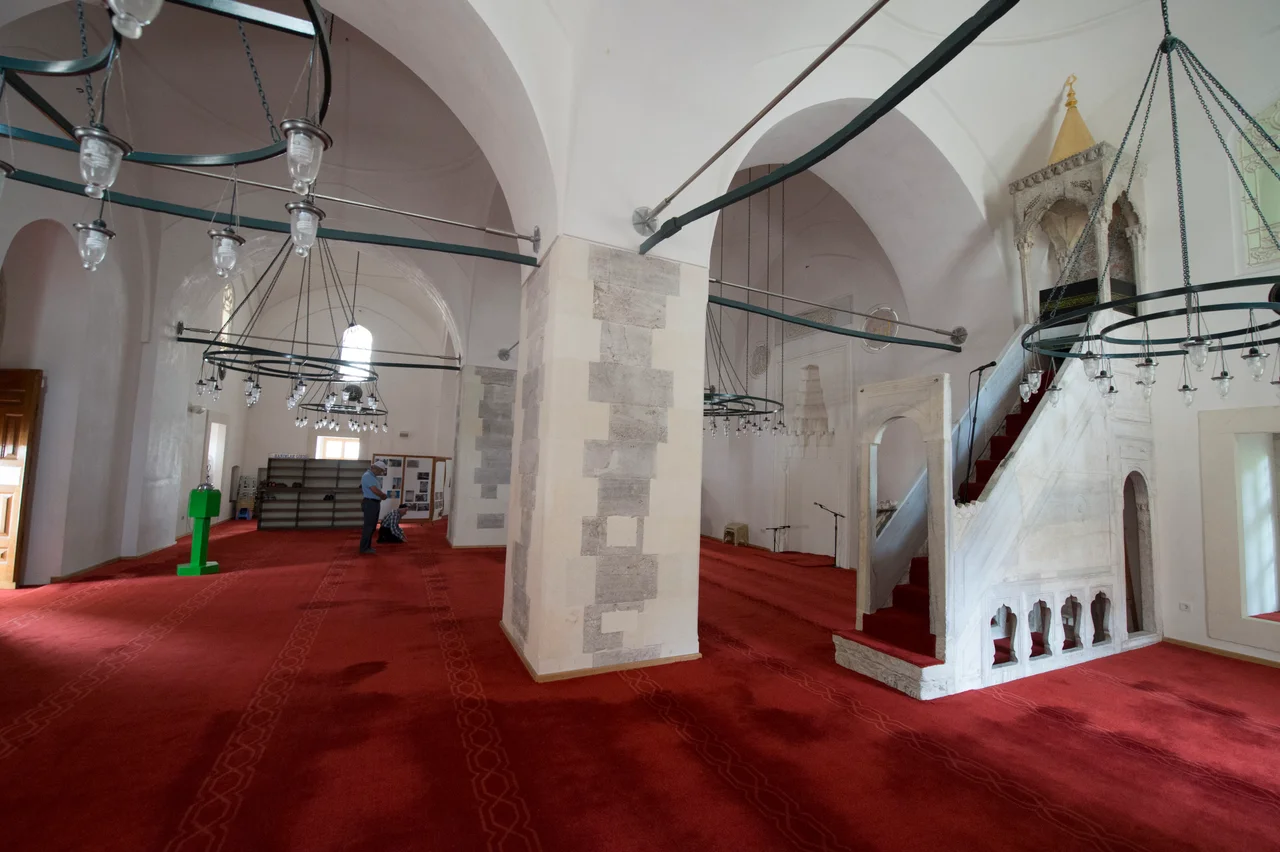

Vasat Atik Ali Pasha Mosque
The Vasat Atik Ali Pasha Mosque was still being built when its patron died. Hadım Atik Ali Pasha, grand vizier to Sultan Bayezid II, ordered the mosque's construction in 1502 on Fevzipaşa Street in the Karagümrük neighborhood of the Fatih district. He died in 1511, one year before the building was completed. The mosque that bears his name finished in 1512 without him — a not uncommon fate for ambitious patrons in a city where construction moved at the pace of available labor, stone, and political favor. What he left behind is unusual enough to merit attention centuries later: one of only two mosques in all of Istanbul with six domes, the other being the Piyale Pasha Mosque. In a city of thousands of mosques, this is a rare distinction.
The Grand Vizier Who Built It
Hadım Atik Ali Pasha served as grand vizier under Sultan Bayezid II, the son of Mehmed the Conqueror. The Ottoman grand vizier was the sultan's chief minister, responsible for running the apparatus of the empire; holding the position required both administrative skill and the ability to survive court politics, which claimed grand viziers at a rate that made the office as dangerous as it was powerful.
Atik Ali Pasha built the mosque on the historic peninsula — the heart of the old city, the area that had been Constantinople — in the neighborhood of Karagümrük, which lies in the Fatih district. Fatih, named for Fatih Sultan Mehmed (the Conqueror), was the district created from the old Byzantine city after 1453. Building a mosque there, in the generation after the conquest, was both an act of religious devotion and a statement about the transformation of the city.
Six Domes in a City of Minarets
The mosque's most striking architectural feature — and the one that distinguishes it in the historical record — is its roof: six domes arranged across the prayer hall. Most Ottoman mosques of this period used a single dominant dome, perhaps with smaller semi-domes, following the model established by Hagia Sophia and refined by Sinan later in the sixteenth century. A mosque with six equal or near-equal domes represents a different structural approach, one less focused on the single grand interior space and more distributed across the building's footprint.
The only other mosque in Istanbul sharing this configuration is the Piyale Pasha Mosque, built later in the sixteenth century. Together they form a small category of their own within Ottoman religious architecture — buildings that chose plurality over the dominant single-dome tradition. The mosque was also long known by a different name entirely: Zincirlikuyu Mosque, after the Zincirlikuyu well beside it — *zincirli* meaning 'chained,' *kuyu* meaning 'well.' The well is gone; the name persisted for centuries before the formal title reasserted itself.
Earthquake, Collapse, and Return
In June 1648, an earthquake brought down the mosque's minaret. The seventeenth century was a difficult one for Istanbul generally — earthquakes, fires, and political instability compounded each other — and this minaret was among many structures in the city damaged or destroyed by the period's recurrent tremors. The minaret was not immediately replaced, and the mosque spent years without its tower for the call to prayer.
The most recent chapter of the minaret's story played out between 2013 and 2015. Repairs began in 2013 at a cost of 2.2 million Turkish lira (approximately $1.03 million at the time), with completion expected in 2014. Documentation from 2015 confirms the restoration was finished. The building that Atik Ali Pasha commissioned five centuries ago, that lost its minaret to an earthquake in 1648, and that stood for decades without it, now stands complete again on Fevzipaşa Street.
A Neighborhood Mosque on the Historic Peninsula
Unlike the great imperial mosques of Istanbul — the Süleymaniye, the Blue Mosque, the Fatih — the Vasat Atik Ali Pasha Mosque was not a statement of sultanic ambition. It was a grand vizier's mosque, built at the scale of a prosperous official rather than an emperor. It served and continues to serve its neighborhood: Karagümrük, a working-class district on the historic peninsula, removed from the tourist circuits that concentrate around the Hippodrome and the great Bosphorus vistas.
That ordinariness is part of what makes it worth noting. Istanbul's historic peninsula contains one of the highest concentrations of significant historical architecture in the world, and many of its finest buildings receive little attention because they are not the grandest examples of their type. The Vasat Atik Ali Pasha Mosque is not Istanbul's most celebrated mosque. It is a mosque with six domes, built by a man who did not live to see it finished, that has stood in its neighborhood for over five centuries.
From the Air
The Vasat Atik Ali Pasha Mosque sits at approximately 41.02°N, 28.94°E in the Karagümrük neighborhood of the Fatih district on Istanbul's historic peninsula. Arriving at Istanbul Airport (LTFM) from the west, the peninsula — bounded by the Golden Horn to the north, the Sea of Marmara to the south, and the Bosphorus to the east — is the most visually distinctive landform in the city. From a viewing altitude of 3,000–5,000 feet, the massed domes of the historic peninsula's great mosques are visible, with Fatih district occupying the central spine of the peninsula. The Vasat Atik Ali Pasha Mosque is a neighborhood-scale structure not individually identifiable from altitude, but it lies within the dense Ottoman fabric of Fatih, inland from the Golden Horn waterfront.
Nearby Stories
- Kocaeli Peninsula 7.6 km away
- Second Battle of Çatalca 11 km away
- Istanbul's Rural Outskirts 14 km away
- MV Struma 20 km away
- HMAS AE2 36 km away
- Bursa 66 km away
- Sangarius Bridge 71 km away
- Januarius MacGahan 101 km away