.jpg)
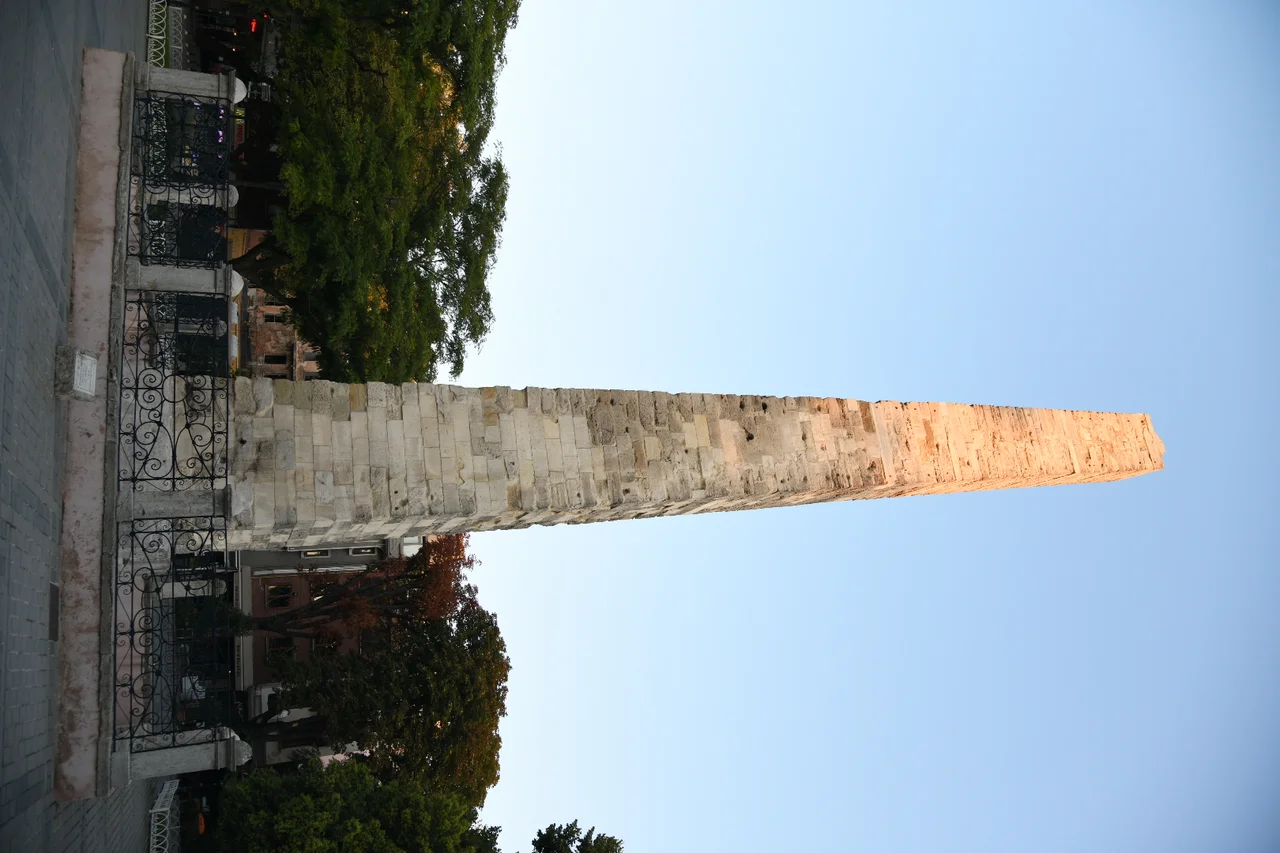
Walled Obelisk
It is the ugly one. Stand at the southern end of what was once the Hippodrome of Constantinople — the great chariot-racing stadium that now exists as Sultanahmet Square, a park lined with monuments — and compare: to the north, the Obelisk of Theodosius, a genuine Egyptian monument of pink Aswan granite, 3,500 years old and still perfectly smooth. To the south, the Walled Obelisk, also called the Masonry Obelisk, a 32-meter stack of rough-cut limestone blocks, pitted and patched, its surface pocked by time and what looks like centuries of casual neglect. The comparison is unfair. It always was. Because the Walled Obelisk was never meant to be seen in naked stone.
Sheathed in Gold
When the obelisk was built — most likely during the Theodosian period of the late 4th or early 5th century, though the original construction date remains uncertain — it stood on the spina, the central barrier of the Hippodrome, as a deliberate counterpart to the Obelisk of Theodosius. The Circus Maximus in Rome had two obelisks on its spina; Constantinople's great rival racecourse did the same. But unlike its neighbor, this obelisk was built entirely of masonry, not monolithic stone. The distinction would have been invisible to a spectator in the stands. The surface was covered entirely in gilded bronze plaques depicting the military victories of Emperor Basil I, the 9th-century soldier-emperor who founded the Macedonian dynasty. The 'tower of brass,' Arab travelers called it in the 10th and 11th centuries. Medieval geographers recorded the detail faithfully, though they sometimes confused it with the Obelisk of Theodosius. The bronze made it gleam.
Constantine's Poem
The 10th-century emperor Constantine VII Porphyrogenitus — 'Born in the Purple,' his epithet meaning he was born to a reigning emperor — had the obelisk restored and re-coated with new gilded bronze plates. He also added something the original builders had not: a Greek inscription in iambic trimeters, the formal verse meter of Byzantine court culture, commemorating the restoration. The inscription mentions his son and successor Romanos II by name. Constantine VII was as famous as a scholar and writer as he was as a ruler, and the choice of iambic trimeters — a studied, literary meter — for a public monument reflects the era's ambitions. The monument was supposed to speak. An Arab geographer of the late 12th to early 13th century, al-Harawi, recorded one vivid detail about the structure: the Byzantine builders had packed potsherds and nuts among the masonry so that, when strong winds caused the stones to shift, the cracking of those objects would serve as an early warning of structural stress. It was an engineering solution disguised as superstition.
Stripped in 1204
The Fourth Crusade ended not in the Holy Land but here, in Constantinople. In April 1204, a Christian army that had set out to recapture Jerusalem instead sacked the greatest Christian city in the world. The destruction was thorough and methodical. Among the monuments targeted were the Hippodrome's bronze artworks, which were systematically removed and melted down to fund the occupying Latin Empire. The gilded bronze plaques on the Walled Obelisk came off then, in 1204, revealing for the first time the rough masonry underneath. The obelisk has been exposed ever since. What you see today in Sultanahmet Square is not the monument as the Byzantines knew it; it is the armature, the skeleton, the thing beneath. The gleaming surface is gone. It will not come back.
What Remains
The three monuments that once stood on the Hippodrome's spina are still there, more or less in their original positions, though the racecourse itself is long gone beneath the square and the streets around it. The Serpentine Column — a bronze tripod from the Temple of Apollo at Delphi, brought to Constantinople by Constantine the Great — stands a few meters from the Walled Obelisk, its three intertwined snakes now missing their heads. The Obelisk of Theodosius still stands on its carved marble pedestal, perfectly intact. And the Walled Obelisk stands between them, the roughest and most battered of the three, stripped of its gold and its story. The inscription Constantine VII added still survives, carved into the base, praising an emperor whose monument no longer looks like what he intended. It is, in its way, a monument to the fragility of imperial ambition.
From the Air
The Walled Obelisk stands at approximately 41.005°N, 28.975°E in Sultanahmet Square on the European side of Istanbul, immediately west of the Blue Mosque (Sultan Ahmed Mosque). At 2,000–3,000 feet, the dense cluster of domes and minarets of the historic peninsula is unmistakable — Hagia Sophia and the Blue Mosque dominate the skyline, with the old Hippodrome visible as an open rectangular space between them. Nearest airport is Istanbul Airport (LTFM), approximately 40 km to the northwest. Visibility over the Bosphorus and the Marmara is excellent in clear conditions.
Nearby Stories
- Kocaeli Peninsula 7.6 km away
- Second Battle of Çatalca 11 km away
- Istanbul's Rural Outskirts 14 km away
- MV Struma 20 km away
- HMAS AE2 36 km away
- Bursa 66 km away
- Sangarius Bridge 71 km away
- Januarius MacGahan 101 km away