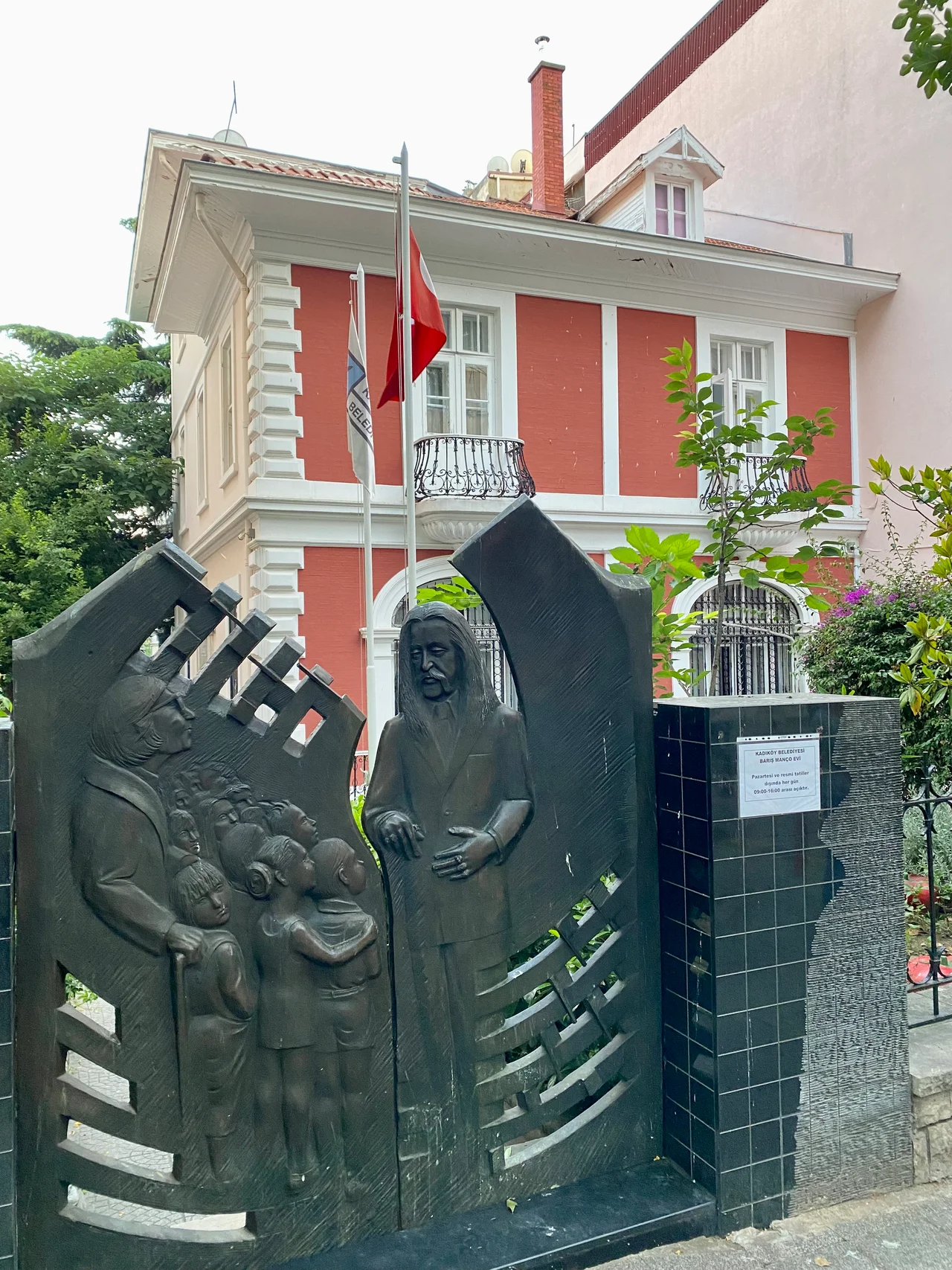

Whittall Mansion, Moda
The Whittall family arrived in Smyrna in 1809 with a plan. Charlton Whittall, born in Liverpool, founded C. Whittall and Co. in 1811 and built one of the most influential British commercial operations in the Ottoman Empire. By the late 19th century, the family's reach extended from the Aegean coast to Constantinople itself, and one branch — James William Whittall — had installed himself in a massive stone house on the Asian shore of Istanbul, in the seaside suburb of Moda, Kadıköy, where he commuted to the European side by private boat, manned by three oarsmen. The mansion his family would build in 1900 outlasted the empire that produced it, survived the century that followed, and ended up as the home of a Turkish rock star. Istanbul does that to buildings.
The Levantines of Moda
The Whittalls belonged to a specific social world — the Levantines of Istanbul, a community of European merchant families (primarily British, Dutch, French, and Italian) who had lived in the Ottoman Empire for generations, occupying an in-between status: not quite Ottoman, not quite foreign, speaking multiple languages, intermarrying across national lines, and accumulating enormous economic influence. The family held Lloyd's Agency for Istanbul and North Turkey for 74 years. They represented British firms, traded in imports and exports, and moved in the highest circles of both Ottoman and European society. In Moda — then a fashionable suburb on the Asian side of the Bosphorus, known for its sea air, its garden villas, and its community of non-Muslim minorities — the Whittalls built on a generous scale. The 1900 mansion was two stories plus an attic, with a long first-floor hall that opened onto a terrace overlooking the lower garden, which ran down to a small jetty on the sea. James William Whittall moored his sailboats at that jetty. The garden — lush with magnolia trees — was known locally as Whittall Park.
Rooms Within Rooms
The interior preserved the textures of a particular kind of late-Ottoman cosmopolitan life. On the first floor, one room was furnished as an 'Oriental Room,' with a charcoal-burning stove, and belonged to Helen's grandmother Lilly — a family member who played pinochle there among some six Aubusson tapestries hanging on the walls. Those tapestries had a history of their own: they were purchased by Enver Pasha, the Ottoman military leader, during World War I. Holes were later punched through their middles to allow stovepipes to pass through, heating the rooms used as a hospital ward for wounded Turkish soldiers. The tapestries' journey — from a French weaving tradition, to a Levantine merchant's wall, to an Ottoman wartime hospital — encapsulates something about the mansion itself: it absorbed the history flowing through it rather than standing apart from it. The sleeping quarters were on the second floor.
A Rock Star's House
Barış Manço was born in Üsküdar in 1943 and grew up to become the founding figure of Anatolian rock — a genre that blended Western electric guitar with traditional Turkish folk sounds and psychedelic elements. He started his first band at Galatasaray High School and released his first composition in 1958. Over the following four decades, he composed around 200 songs and became one of the best-selling Turkish artists of all time. In the 1980s and 1990s, he hosted a television program called '7'den 77'ye' ('From 7 to 77') that turned him into a figure beloved across generations. In 1984, he purchased the Whittall Mansion itself — by then in the hands of the last Whittall family members — and had it restored to its original condition, living there until his death on February 1, 1999, at age 56. In 2010, the Kadıköy Municipality opened the mansion as the Barış Manço Museum, honoring both the rock icon who made it his home and the Levantine family who built it — two chapters of the Asian shore's history preserved in the same building.
The Asian Shore's Particular Character
Moda is one of those Istanbul neighborhoods that the European side tends to overlook — which is part of why it has kept something that Beyoğlu and the old city have increasingly lost: a neighborhood life at human scale. The streets around the mansion are lined with early 20th-century apartment buildings, the waterfront promenade attracts families and cyclists in the evening, and the ferries from Kadıköy to Eminönü carry commuters who cross the Bosphorus twice a day as a matter of routine. The Whittall Mansion sits in this fabric as a building that never entirely belonged to a single era. Levantine in its origins, Ottoman in its legal context, later used as a wartime hospital, eventually a museum — it reflects the layered, unresolved, cosmopolitan character of the Asian shore itself.
From the Air
The Whittall Mansion is located at approximately 40.982°N, 29.021°E in the Moda neighborhood of Kadıköy, on the Asian side of Istanbul. Approaching from the south at 2,000–3,000 feet, the Kadıköy waterfront and the ferry terminals are the primary navigation reference; Moda's residential streets extend southeast from the main Kadıköy hub. The Bosphorus strait is visible to the northwest, with the European skyline — including the minarets of the historic peninsula — prominent in clear conditions. Nearest airport for the Asian side is Sabiha Gökçen Airport (LTFJ), approximately 30 km to the southeast.
Nearby Stories
- Kocaeli Peninsula 7.6 km away
- Second Battle of Çatalca 11 km away
- Istanbul's Rural Outskirts 14 km away
- MV Struma 20 km away
- HMAS AE2 36 km away
- Bursa 66 km away
- Sangarius Bridge 71 km away
- Januarius MacGahan 101 km away