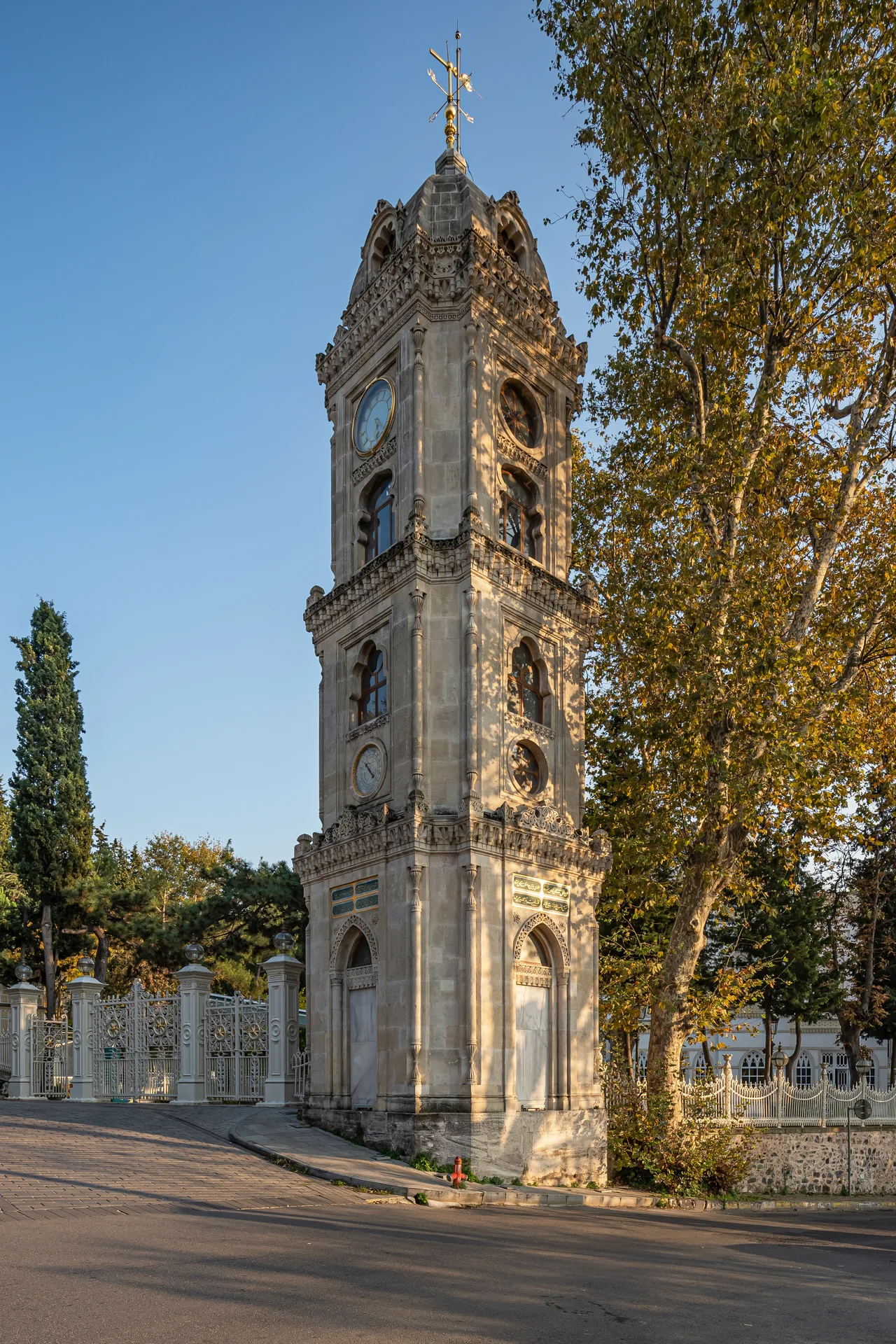

Yıldız Clock Tower
Sultan Abdülhamid II did not trust easily, and he trusted the world outside the Yıldız Palace grounds least of all. By the 1880s he had retreated almost entirely into his hilltop complex in Beşiktaş — a vast compound of palaces, pavilions, workshops, and gardens above the Bosphorus — rarely venturing out, governing through reports and telegrams, receiving visitors inside the grounds where he felt secure. In 1889, within that same compound, he ordered the construction of a clock tower beside the courtyard of the Yıldız Hamidiye Mosque. It was finished in 1890. The tower is small, ornate, and peculiarly mixed in its architectural vocabulary — part Ottoman, part neo-Gothic — and it stands today exactly where Abdülhamid placed it, a monument to a sultan who measured everything and controlled what he could.
The Sultan Who Built Everything
Abdülhamid II reigned from 1876 to 1909, longer than any Ottoman sultan of the 19th century, and he was the most prolific builder among them. Clock towers appeared across the empire during his reign — in İzmir, İzmit, at the Dolmabahçe Palace, at the Etfal Hospital, in provincial capitals from Lebanon to Macedonia. Each one was a statement about modernity, about the synchronization of the empire to a shared, rational sense of time. The Yıldız Clock Tower was the one closest to home, just outside the mosque he had built for himself in his palace grounds. The Yıldız Hamidiye Mosque, completed in 1886, was where Abdülhamid prayed each Friday in a carefully staged ceremony called the Selamlık, one of his rare, controlled public appearances. The clock tower was therefore a permanent feature of that ceremony's backdrop — a vertical mark of order beside a place of devotion.
Form and Function
The tower is three stories high on an octagonal plan. The choice of the octagon is both aesthetic and symbolic — in Islamic architectural tradition, the octagon frequently appears as a transitional form between the square of earth and the circle of heaven. The first floor bears four inscriptions on its exterior faces. The second floor houses a thermometer and a barometer — instruments of observation and measurement. The top floor is the clock room itself. A decorative roof caps the structure, and atop it sits a compass rose. The architectural style mixes Ottoman detail with neo-Gothic pointed arches and ornamental elements that reflect the broader eclecticism of late-Ottoman building culture, which was absorbing European influences at speed during Abdülhamid's reign. The whole composition is compact and precise — more jewel-box than landmark — but its presence beside the mosque courtyard gives it a ceremonial weight that its modest scale alone would not suggest.
The Yıldız Compound
To understand the tower's position, you have to understand the place it inhabits. The Yıldız Palace complex — yıldız means 'star' in Turkish — covers a large wooded hillside above the Bosphorus in Beşiktaş. It began as a small summer lodge for earlier sultans and was progressively expanded. Abdülhamid turned it into his permanent residence and, in effect, the center of the Ottoman government. Within the walls, he built workshops for carpentry, ceramics, and theater; he kept a menagerie; he entertained Kaiser Wilhelm II of Germany here during the latter's 1889 visit to Istanbul. The Hamidiye Mosque was integral to the compound's design, giving it a mosque without requiring the sultan to travel. The clock tower stands at the edge of the mosque courtyard, at the entry point between the public and private parts of the complex — a threshold marker between the sultan's world and the world beyond the gate.
A Tower That Remained
Abdülhamid II was deposed by the Young Turk revolution in 1909 and died in 1918 under house arrest. The Yıldız compound passed through various uses in the Republican era — parts became a public park, others housed the Yıldız Technical University. The Hamidiye Mosque continued as an active place of worship, and the clock tower beside it continued to mark time. The clock was repaired in 1993. Today the tower stands in one of the least-visited corners of Beşiktaş, tucked behind the mosque courtyard on the steep hill above the Bosphorus. It is not famous. But it is precise. The barometer and thermometer still occupy the second floor. The compass rose still points from the roof. Whatever the weather, whatever the politics, the tower goes on measuring.
From the Air
The Yıldız Clock Tower stands at approximately 41.050°N, 29.010°E in the Beşiktaş district on the European side of the Bosphorus. At 3,000–4,000 feet, the Bosphorus strait is the dominant navigation feature immediately below; the densely wooded hillside of the Yıldız Palace grounds is visible as a large green area above the Beşiktaş waterfront. The Dolmabahçe Palace is approximately 1.5 km to the south along the shoreline. Nearest airport is Istanbul Airport (LTFM), approximately 25 km to the northwest.
Nearby Stories
- Kocaeli Peninsula 7.6 km away
- Second Battle of Çatalca 11 km away
- Istanbul's Rural Outskirts 14 km away
- MV Struma 20 km away
- HMAS AE2 36 km away
- Bursa 66 km away
- Sangarius Bridge 71 km away
- Januarius MacGahan 101 km away