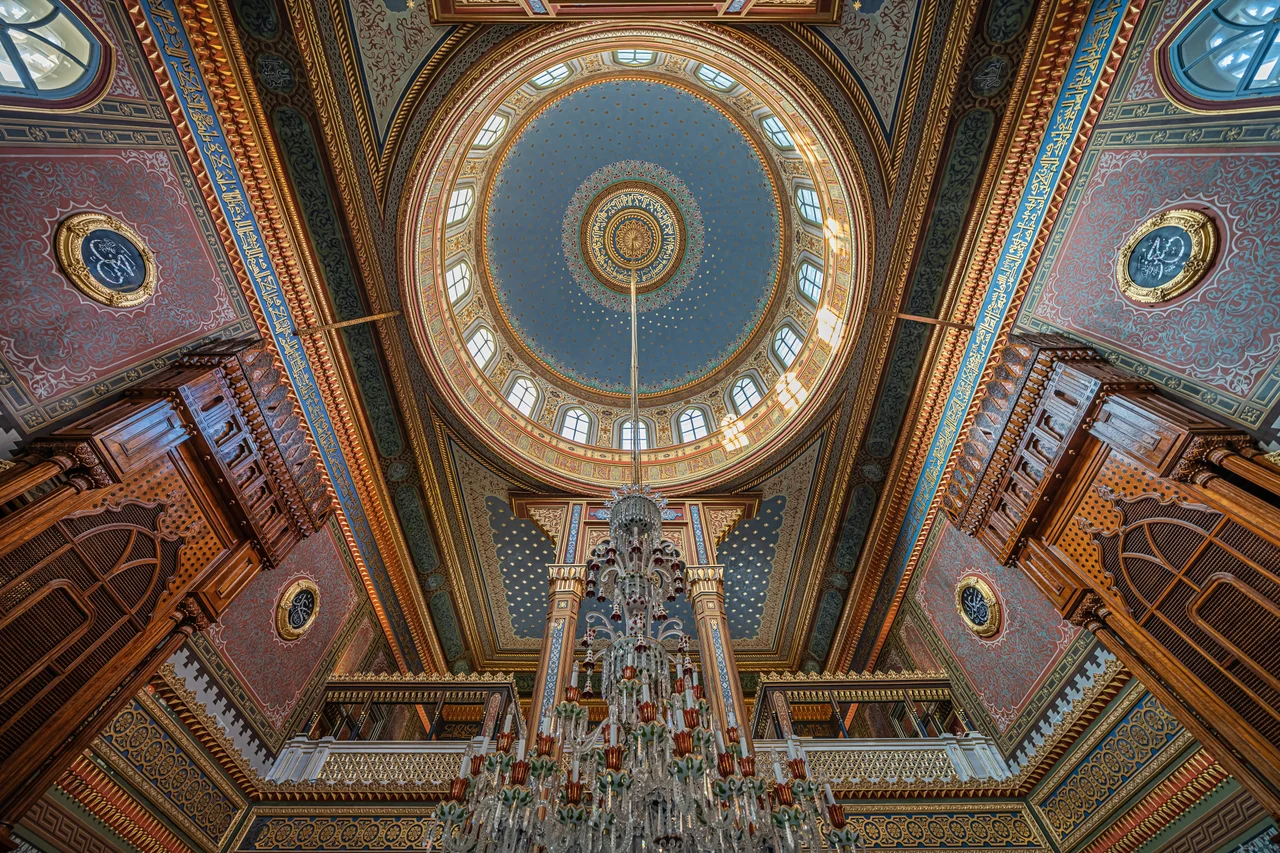

Yıldız Hamidiye Mosque
On Friday mornings in the late nineteenth century, Istanbul held its breath. Sultan Abdülhamid II — reclusive, suspicious, ruling an empire that felt itself slowly crumbling — would emerge from the sealed world of Yıldız Palace to attend Friday prayers at the mosque he had built for himself just outside the palace gates. The procession was the one moment the sultan was visible to his people. It was also the one moment he was exposed. On 21 July 1905, that exposure nearly proved fatal.
A Sultan's Private House of Worship
Abdülhamid II commissioned the Yıldız Hamidiye Mosque in 1884 and saw it completed two years later, in 1886. It stands in the Yıldız neighbourhood of Beşiktaş, positioned deliberately at the palace perimeter so the sultan could walk from his compound to pray with minimal time in the open. The architecture is an unusual and striking fusion: Neo-Gothic forms — pointed arches, vertical emphasis, European ecclesiastical rhythm — married to classical Ottoman motifs. One minaret rises over a rectangular plan, and the interior dome carries the calm grandeur of an imperial prayer hall while its exterior silhouette hints at the cross-cultural anxieties of the late Ottoman age. The architect was Sarkis Balyan, from the Armenian dynasty of court builders who shaped Istanbul's nineteenth-century waterfront. The mosque was a private statement as much as a public one — an emperor's acknowledgment that even a sovereign must bow, but that he intended to do so on his own carefully controlled terms.
The Bomb in the Carriage
The morning of 21 July 1905 began like any other Friday procession. Abdülhamid II attended prayers, then lingered inside the mosque to speak with the Sheikh ul-Islam. That unplanned delay saved his life. Outside, a horse-drawn carriage packed with explosives detonated as the sultan's entourage was reassembling — but Abdülhamid had not yet emerged. Twenty-six people were killed. Fifty-eight more were wounded. The bomb had been placed by members of the Armenian Revolutionary Federation, the operation organized in response to the Hamidian massacres — a decade of organized violence against Armenians and other minorities carried out under the sultan's government in the 1890s. The perpetrators had targeted a tyrant; the bomb killed bystanders. The attempt failed, the sultan survived, and the event reverberated through European chancelleries and Ottoman politics alike. It is known today as the Yıldız assassination attempt — one of the most dramatic episodes in the mosque's long history, and impossible to separate from the larger story of what Abdülhamid II's reign meant for the peoples of the Ottoman Empire.
A Replica Far Away
Abdülhamid II left architectural echoes across the empire. In Damascus, he erected a bronze colonnade in Marjeh Square — and atop it, a replica statue of the Yıldız Mosque, a miniature of his Istanbul prayer house transplanted to the heart of Ottoman Syria. The gesture was characteristic: part piety, part territorial assertion, part personal branding in stone and metal. The Damascus column is long gone, but the Istanbul original endures. After more than a century of use, the mosque closed for restoration in 2013. Four years of work, at a cost of 27 million Turkish liras, brought it back to life. President Recep Tayyip Erdoğan presided over its reopening on 4 August 2017. Worshippers returned to a building whose pale stone and pointed arches look almost European from the street, but whose interior breathes the devotional hush of Ottoman sacred space. Whatever one makes of the man who built it, the mosque itself is exquisite — a hybrid building for a hybrid age.
A Neighborhood That Bears His Name
The Yıldız quarter takes its identity from the palace complex, and the mosque anchors its street-level life. On an ordinary afternoon, the building sits quietly off the road that climbs toward the palace gates, its single minaret catching the afternoon light that rolls in off the Bosphorus. The Friday procession that defined the sultan's public life is long past, but the mosque remains an active place of worship. The streets around it carry the mixed flavor of Beşiktaş: a cosmopolitan, traffic-dense Istanbul district where the nineteenth century persists in facades and alleyways while the twenty-first presses in around the edges. The Hamidiye Mosque is neither the largest nor the oldest of Istanbul's imperial mosques, but it may be the most historically charged — a building where the personal and the political, the devotional and the murderous, converged on a July morning more than a century ago.
From the Air
The Yıldız Hamidiye Mosque sits at approximately 41.049°N, 29.010°E on the European shore of Istanbul, in the Beşiktaş district just below the hillside complex of Yıldız Palace. From the air at 3,000–5,000 feet, the palace hillside is visible rising above the Bosphorus, with the mosque's single minaret marking the palace entrance road. The nearest major airport is Istanbul Airport (LTFM), roughly 35 km to the northwest on the European shore. In clear weather, the full sweep of the Bosphorus strait and the city's historic peninsula are visible from approach altitudes.
Nearby Stories
- Kocaeli Peninsula 7.6 km away
- Second Battle of Çatalca 11 km away
- Istanbul's Rural Outskirts 14 km away
- MV Struma 20 km away
- HMAS AE2 36 km away
- Bursa 66 km away
- Sangarius Bridge 71 km away
- Januarius MacGahan 101 km away