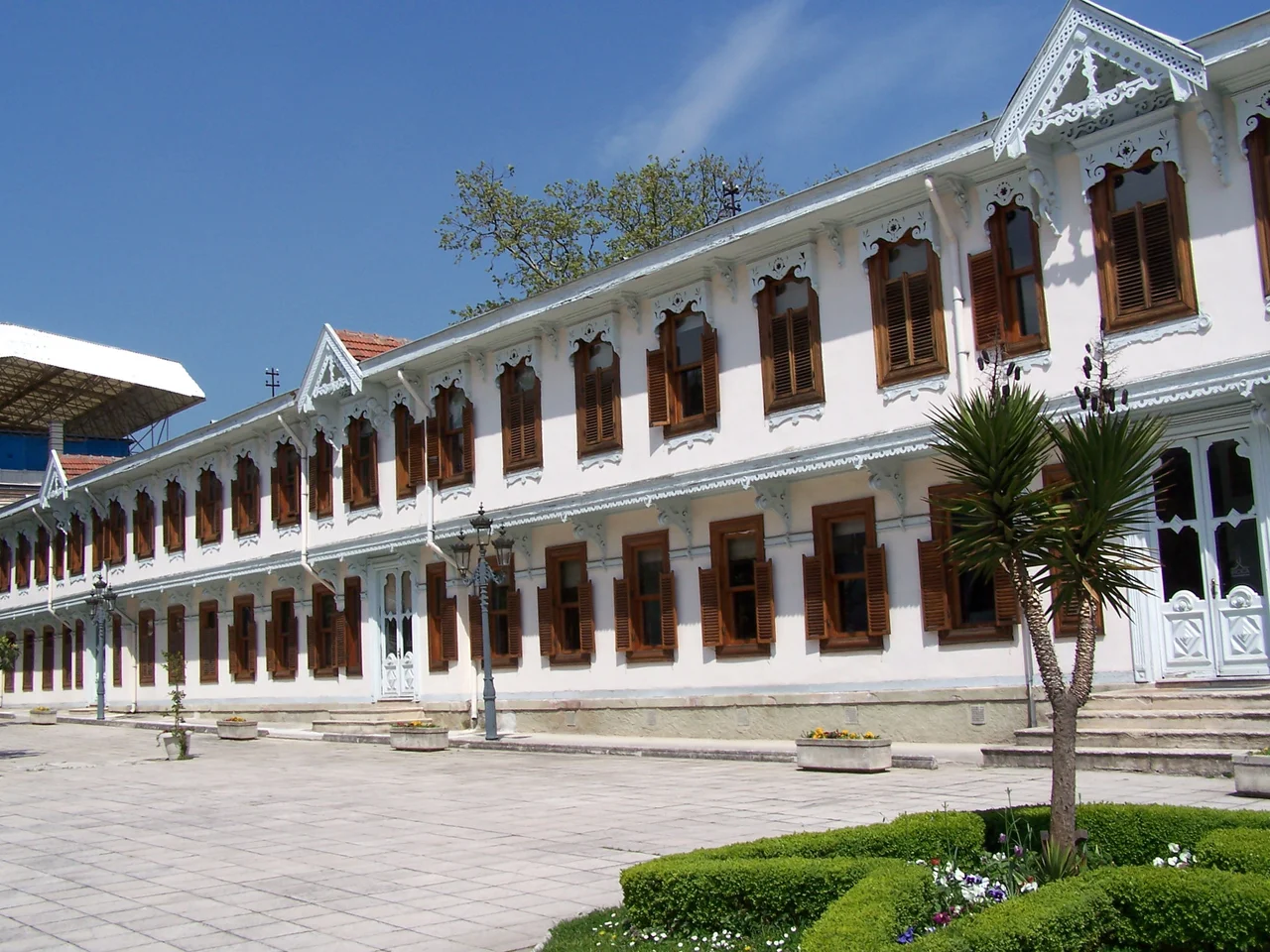

Yıldız Palace
Sultan Abdülhamid II was afraid of the sea. Or rather, he was afraid of what could come across it — a warship, an assassin, a revolution arriving by water. So in the late 1870s he abandoned the magnificent Dolmabahçe Palace on the Bosphorus shore and retreated uphill, into the wooded slopes above Beşiktaş, to a complex he would spend the next three decades expanding, fortifying, and inhabiting with the obsessive intensity of a man who trusted almost no one. He called it Yıldız — the Star.
The Palace That Grew from a Forest
The land had been imperial territory since the reign of Sultan Ahmed I in the early seventeenth century, when the wooded hillside above the Bosphorus became a retreat for the court. Suleiman the Magnificent's era saw it used as hunting grounds. The first actual pavilion — Yıldız Kasrı — was built by Selim III between 1798 and 1808 as a gift for his mother, Mihrişah Sultan. Later sultans added mansions and kiosks on the slope, but the site remained a collection of scattered summer buildings until Abdülhamid II arrived and transformed the whole hillside into the seat of Ottoman government. He commissioned Italian architect Raimondo D'Aronco to design new structures, engaged court architect Sarkis Balyan for others, and built outward in every direction — pavilions, workshops, a theater, a porcelain factory, gardens stocked with rare plants from across the empire. When he moved there, Yıldız became the fourth seat of Ottoman government after the Old Palace in Edirne, Topkapı, and Dolmabahçe.
Three Courtyards, Three Lives
The palace is organized around three courtyards, each serving a different world. The first courtyard held the machinery of state: government offices, an armory, and Abdülhamid's extensive personal library. Officials and dignitaries moved through this zone; it was the empire's administrative face. The second courtyard was private — the sultan's family quarters, removed from public gaze. The third courtyard was garden, tended with the sultan's characteristic thoroughness: rare botanical specimens, an artificial lake, and the Yıldız Tile Factory, where craftsmen produced the porcelain the empire exported as luxury goods. The Büyük Mabeyn served as state apartments for officials, and the Yıldız Theatre and Opera House — built in 1889 with a domed ceiling painted with stars, a reference to the palace name — held court performances. No one was permitted to sit with his back to the sultan, so the royal balcony box was positioned in such a way that the first row of seats was never used.
The Şale Kiosk and Its Remarkable Guests
Abdülhamid II's more personal residence within the complex was the Şale Kiosk, built in three phases across two decades. The first section, designed by Sarkis Balyan to resemble a Swiss chalet — şale means chalet in Turkish — went up in wood between 1877 and 1879. A second section followed in 1889, built to accommodate Kaiser Wilhelm II, who became the first foreign monarch to visit Constantinople; this addition included the Sedefli Salon, its walls and surfaces covered almost entirely in mother-of-pearl. A third section, in stone masonry, was added in 1898 for the Kaiser's second visit. The reception chamber built in that final phase remains the most magnificent room in the complex: a single hand-woven carpet covering more than 400 square meters, completed by sixty weavers; a gilded coffered ceiling; large mirrors amplifying the light. Winston Churchill and Charles de Gaulle later visited this same pavilion. Abdülhamid II was a skilled carpenter and made some of the furniture on display himself.
Porcelain, Paranoia, and the End of an Era
The Imperial Porcelain Factory, opened in 1895, was one of the palace complex's most commercially ambitious projects — built to supply the upper classes with European-style ceramics, its bowls, vases, and plates often depicting idealized views of the Bosphorus. The factory building itself looks like a European medieval castle, an anomaly even within a complex full of architectural surprises. Abdülhamid II ruled from Yıldız until he was deposed in 1909, after which the palace passed through phases that would have astonished its builder: luxury casino, guesthouse for visiting heads of state, then museum. The Yıldız Palace Museum closed in 2018 for restoration and reopened in July 2024. The gardens, open to the public as Yıldız Park, remain one of Istanbul's most beloved green spaces — wooded slopes above the Bosphorus where families picnic in the shade of trees the paranoid sultan planted.
From the Air
Yıldız Palace sits at approximately 41.049°N, 29.011°E on the European side of Istanbul, on the wooded hillside above the Beşiktaş district. From the air, the complex appears as a dense cluster of buildings embedded in tree cover, with the Bosphorus strait immediately below and to the east. The Çırağan Palace — connected to Yıldız by a bridge through the park — is visible on the Bosphorus waterfront. Istanbul Airport (LTFM) lies approximately 35 km to the northwest. A viewing altitude of 3,000–5,000 feet on a clear day reveals the full topographic logic of the site: the hill, the palace, the water, and the city.
Nearby Stories
- Kocaeli Peninsula 7.6 km away
- Second Battle of Çatalca 11 km away
- Istanbul's Rural Outskirts 14 km away
- MV Struma 20 km away
- HMAS AE2 36 km away
- Bursa 66 km away
- Sangarius Bridge 71 km away
- Januarius MacGahan 101 km away