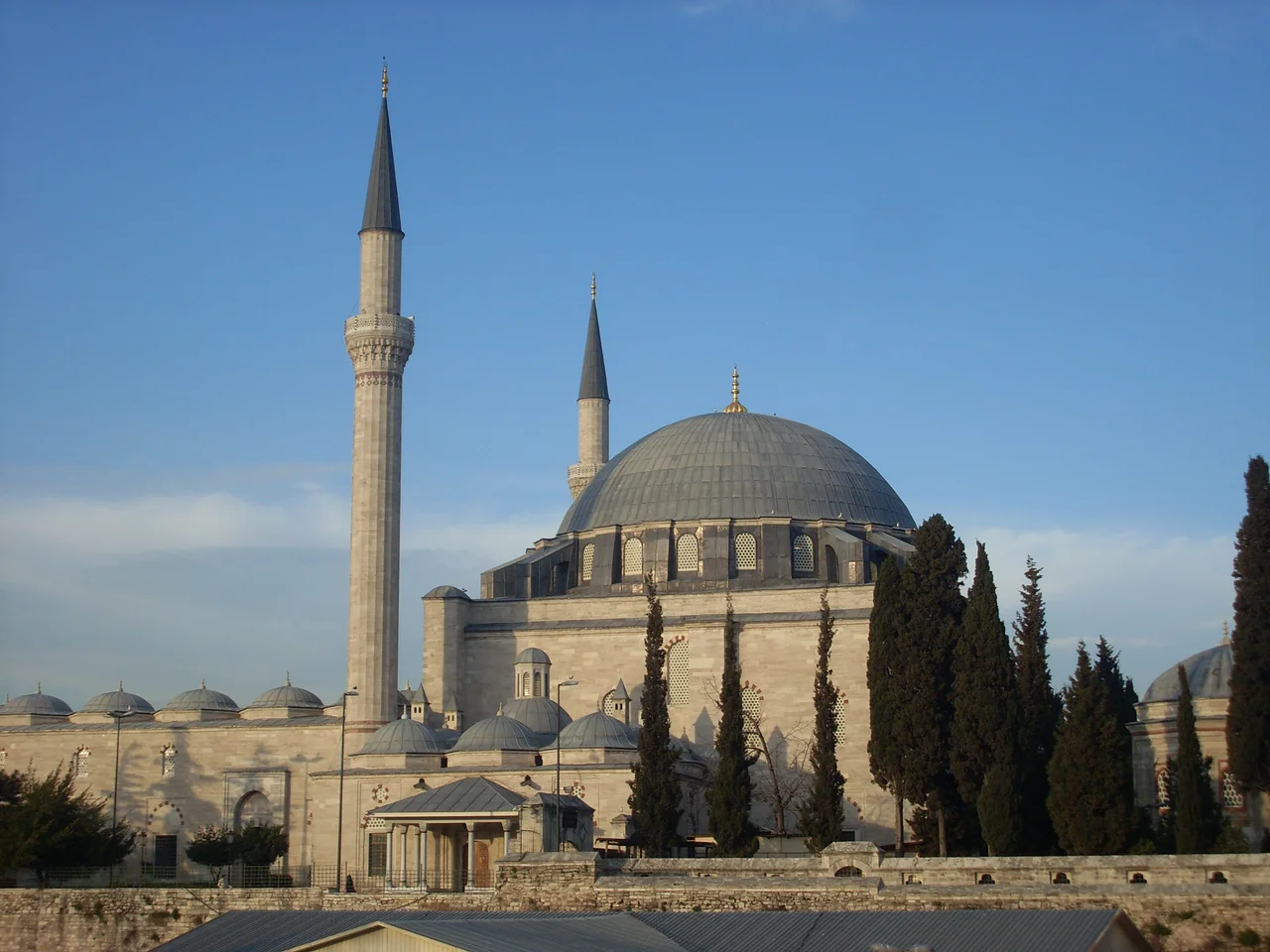

Yavuz Selim Mosque
Suleiman the Magnificent built this mosque for his father, and the choice of site says everything about the intention. The fifth hill of Istanbul rises steeply above the Golden Horn, and from its crown you can see the water below, the city spreading in every direction, and — on the clearest days — the Asian shore across the strait. It is the kind of location a son chooses when he wants the world to see that his father mattered. Selim I died in 1520. His mosque was completed in 1527 or 1528. It has presided over that hilltop ever since.
The Conqueror's Son and His Architect
Selim I — Yavuz Selim, the Grim, as history remembers him — was one of the most consequential Ottoman sultans: the conqueror of Egypt, Syria, and the Hejaz, the man who transferred the caliphate to Ottoman hands and who dramatically expanded the empire's reach in a reign of less than a decade. He died at fifty in 1520, before he could attempt the conquest of Vienna that some historians believe he had in mind. His son Suleiman inherited an empire transformed and built this mosque as a memorial. The architect was Alaüddin, also known as Acem Alisi. Despite later attempts to attribute the structure to Mimar Sinan — the greatest of all Ottoman architects — there is no documentary evidence to support the claim, and the mosque predates Sinan's major imperial commissions. One of the tomb structures in the garden, however, is confirmed as Sinan's work.
The Geometry of Devotion
The mosque rests on a terrace overlooking the Cistern of Aspar — the largest of the three great Roman water reservoirs built into the bedrock of Constantinople. The large courtyard, called avlu, is lined with a colonnaded portico whose columns draw from several types of marble and granite, their variety a quiet record of imperial reach. Twin minarets flank the prayer hall. Inside, the plan is a pure square: 24.5 meters on each side, covered by a shallow dome rising 32.5 meters. Like the Hagia Sophia's dome, it is much flatter than a full hemisphere — a choice that creates a sense of hovering lightness rather than enclosing weight. The windows carry lunette panels of polychrome cuerda seca tiles, a technique of firing colored glazes separated by threads of wax. These tiles were almost certainly produced by Iranian craftsmen working for the Ottoman court; their closest relatives appear in the Circumcision Room of Topkapı Palace. To north and south, domed passages lead to four small rooms designed as hospices for traveling dervishes.
A Garden Full of Tombs
Behind the mosque, a garden overlooks the Golden Horn and holds three Ottoman türbe — the domed mausoleum structures that mark the resting places of those the empire wished to honor. The most prominent is the octagonal türbe of Selim I himself, completed in 1523, its porch decorated with panels of tiles of unusual design. A second octagonal türbe, attributed to Mimar Sinan and dated to 1556, contains the tombs of three sons of Suleiman the Magnificent — Mahmud, Murad, and Abdullah — and two daughters of Selim I, Hafize Hafsa and Hatice. These were children and grandchildren caught in the brutal dynastic arithmetic of the Ottoman succession, where princes were often executed to secure a reigning sultan's throne. Their tombs, elaborately inscribed in carved stone, are beautiful and melancholy in equal measure. A third türbe holds Sultan Abdülmecid I, who died in 1861 — adding a nineteenth-century chapter to the garden's sixteenth-century story.
Austere, Beloved, Enduring
The Yavuz Selim Mosque is not the most famous of Istanbul's imperial mosques. The Süleymaniye and the Blue Mosque draw larger crowds, their silhouettes more familiar from postcards and travel guides. But the mosque on the fifth hill has a reputation among those who seek it out: for its quietness, its clean geometry, its refusal of decoration for its own sake. The tiles are magnificent but spare. The courtyard is generous without being showy. The setting — high above the Golden Horn, the water visible through the garden behind the türbe — gives the whole complex a contemplative quality that the more celebrated mosques, thronged with visitors, can rarely offer. Suleiman built it for his father's memory, and it honors that memory well: an austere, beautiful building on a commanding site, the kind of place where the city's noise stays below and the history above feels close enough to touch.
From the Air
The Yavuz Selim Mosque sits at approximately 41.027°N, 28.951°E on the fifth hill of Istanbul's historic peninsula, in the Çukurbostan neighbourhood of the Fatih district, overlooking the Golden Horn. From the air, the mosque's twin minarets are visible rising above the densely built hilltop. The Golden Horn curves below to the northeast. Istanbul Airport (LTFM) lies approximately 30–35 km to the northwest. On approach over the European city at 2,000–4,000 feet, the five historic hills of the old city are distinguishable as topographic ridges, with the Yavuz Selim Mosque crowning the outermost one closest to the old land walls.
Nearby Stories
- Kocaeli Peninsula 7.6 km away
- Second Battle of Çatalca 11 km away
- Istanbul's Rural Outskirts 14 km away
- MV Struma 20 km away
- HMAS AE2 36 km away
- Bursa 66 km away
- Sangarius Bridge 71 km away
- Januarius MacGahan 101 km away