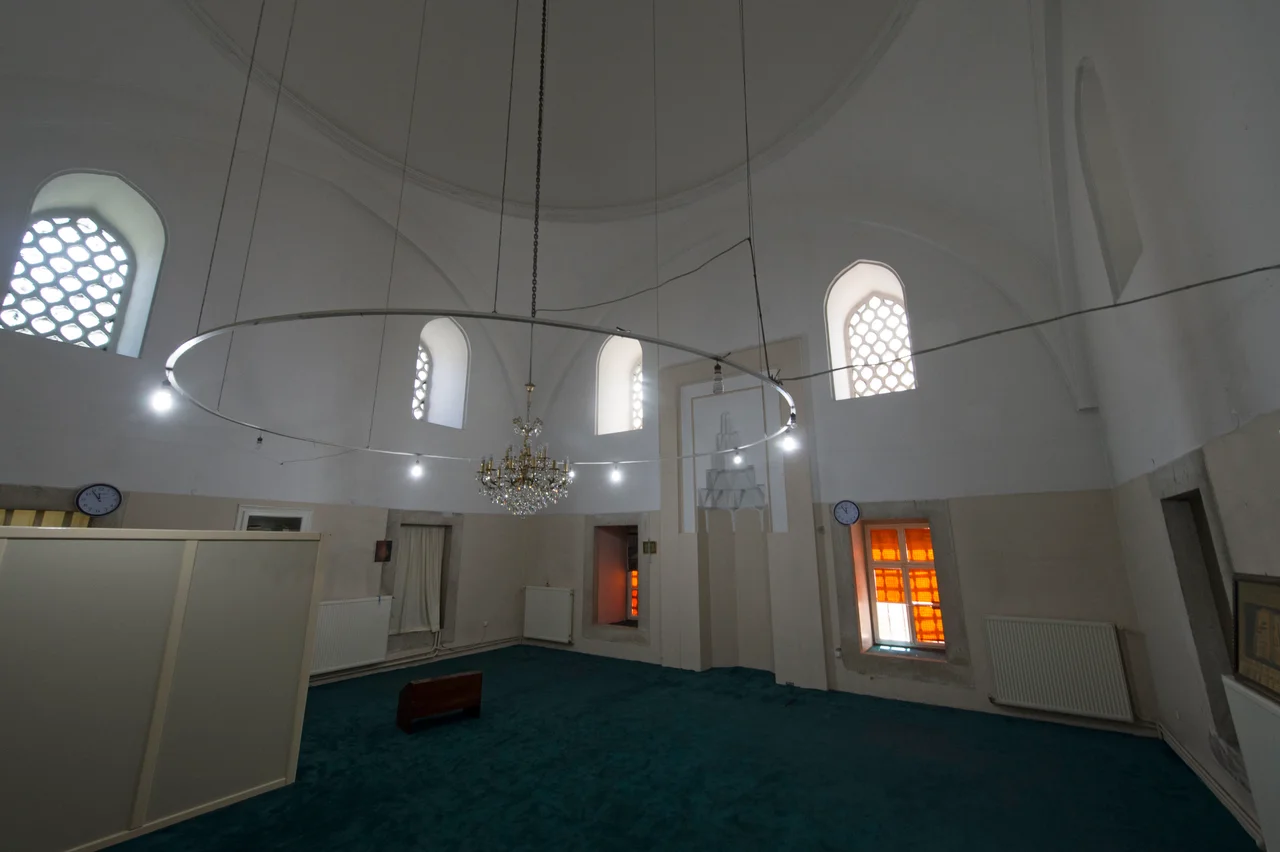

Yavuz Sultan Selim Medrese
Before Selim I became one of the most feared and capable rulers in Ottoman history, before he doubled the empire's territory in a decade of relentless campaigning, he stood on a hill in Constantinople and made a quiet request: he wanted a school built on the ground where his tent had stood. That wish outlasted him. Mimar Sinan, already the greatest architect in the empire, constructed the medrese between 1548 and 1550 — nearly thirty years after Selim's death — as a memorial in stone to a sultan whose ambitions had always been larger than any single victory. Today the courtyard sits half-hidden behind the signage of modern Istanbul, hemmed by a four-lane highway, but the domed lecture hall and its U-shaped arcade still speak clearly of what a 16th-century Ottoman education was supposed to look like.
The Sultan Who Asked for a School
Selim I came to power in 1512 and ruled for eight years, but the energy packed into that decade reshaped the Near East. He defeated the Safavids at Chaldiran, conquered Mamluk Egypt, and brought the holy cities of Mecca and Medina under Ottoman protection. Historians call him Yavuz — the Stern, or the Grim — and the epithet was earned. Yet the story attached to this medrese is a different kind of portrait. When Selim deployed his campaign tent on this hill in Istanbul's Fatih district, he reportedly declared that an educational institution should be raised on the spot when he was gone. Whether the words were spoken exactly as tradition remembers them, the intent was clear enough for Sinan to carry out the commission decades later. The medrese that resulted bore Selim's honorific name — Yavuz Sultan Selim — and the full title of the complex eventually known also as the Yenibahçe Selim Medrese.
Sinan's Courtyard Logic
Mimar Sinan designed the building around what Ottoman architects called the U-plan: three wings of arcaded student rooms opening onto a central courtyard, with the lecture hall closing the fourth side beneath a large dome. A domed gatehouse marks the main entrance; beyond it, a forecourt gives way to the courtyard proper, where a small fountain anchors the center. The arrangement is functional and serene — each student cell a contained world, the shared courtyard a place for debate and reflection. A small iwan tucked into the southwestern corner served as a secondary space of some importance, signaled by the more deliberate approach its position required. A passage to the east opened onto an enclosed garden, and a small projecting element — likely screening the toilets — completed the ensemble with typical Sinan discretion. Nothing is accidental in a Sinan plan; every transition from public to private, from movement to stillness, is carefully considered.
From Classroom to Kitchen to Clinic
The building's history after the classical period is one of gradual reinvention. In 1563, responding to requests from the local community, Sinan himself returned to convert the lecture hall into a small mosque — a mescid — and added a minaret. The neighborhood changed around it over the centuries. A fire in 1914 caused minor damage; a more disruptive blaze in 1918 struck when the medrese was already being used as a public kitchen, part of the charitable food distribution that had replaced formal education as the building's main purpose. The minaret was lost in 1942 and never rebuilt. Restoration work began in earnest in 1958, and by 1962 the medrese had reopened as the Turkish Calligraphic Arts Museum — the Türk Hat Sanatları Müzesi — a fitting use for a space whose arched cells and domed hall are themselves exercises in geometric proportion. More recently, the structure has served as a clinic affiliated with Medipol University.
Layers Beneath the Surface
The medrese does not stand alone. In its immediate neighborhood, a public fountain and the tomb of Shah Huban Hatun are reminders that Ottoman urban planning wove charitable, devotional, and educational functions into the same blocks. More startling is what lies nearby: the Fenari Isa Mosque, which was once a Byzantine double-church monastery. The first church was built in 908 by Constantine Lips, an official at the court of the emperors Leo VI and Constantine VII Porphyrogenitus, dedicated to the Theotokos. After 1261, the Empress Theodora Palaiologina added a second church with a chapel for St. John the Baptist. The complex was converted to a mosque in 1496 and abandoned after a fire in the early twentieth century. Standing between a 10th-century Byzantine monastery-turned-mosque and a 16th-century Ottoman medrese, this corner of Fatih compresses more than a thousand years of the city's layered identity into a few short blocks.
Finding It Today
Arriving at the medrese from the north, it is easy to walk past without recognizing it. The building sits lower than the surrounding street level — the land has risen roughly two meters over the centuries — and the exterior walls are plastered with commercial signage. The four-lane Vatan Caddesi cuts through what was once a more navigable network of streets, making a pedestrian approach more complicated than the architecture deserves. Halıcılar Köşkü Caddesi, which might otherwise create a coherent route linking the Fenari Isa Mosque, the medrese, and the nearby tombs, is fractured by modern cross-streets. The medrese rewards the visitor who finds it, though: step through the domed gateway, and the courtyard's proportions and the dome above the old lecture hall still do what Sinan intended — they quiet the noise outside and shift your attention to something older and more deliberate.
From the Air
The Yavuz Sultan Selim Medrese sits at approximately 41.017°N, 28.942°E on the historic peninsula of Istanbul, in the Fatih district. Flying in from the northwest toward Istanbul Airport (LTFM), the dense red-tiled roofscape of the historic peninsula is visible across the Sea of Marmara. The medrese is close to the prominent ridge that runs through Fatih, not far from the larger Selim I Mosque complex which dominates the hilltop. At 1,500 feet or below, the Ottoman domes and minarets of Fatih become individually distinguishable, with the Sea of Marmara to the south and the Golden Horn to the north providing excellent geographic orientation. Nearest major airport is LTFM (Istanbul Airport), approximately 35 km to the northwest.
Nearby Stories
- Kocaeli Peninsula 7.6 km away
- Second Battle of Çatalca 11 km away
- Istanbul's Rural Outskirts 14 km away
- MV Struma 20 km away
- HMAS AE2 36 km away
- Bursa 66 km away
- Sangarius Bridge 71 km away
- Januarius MacGahan 101 km away