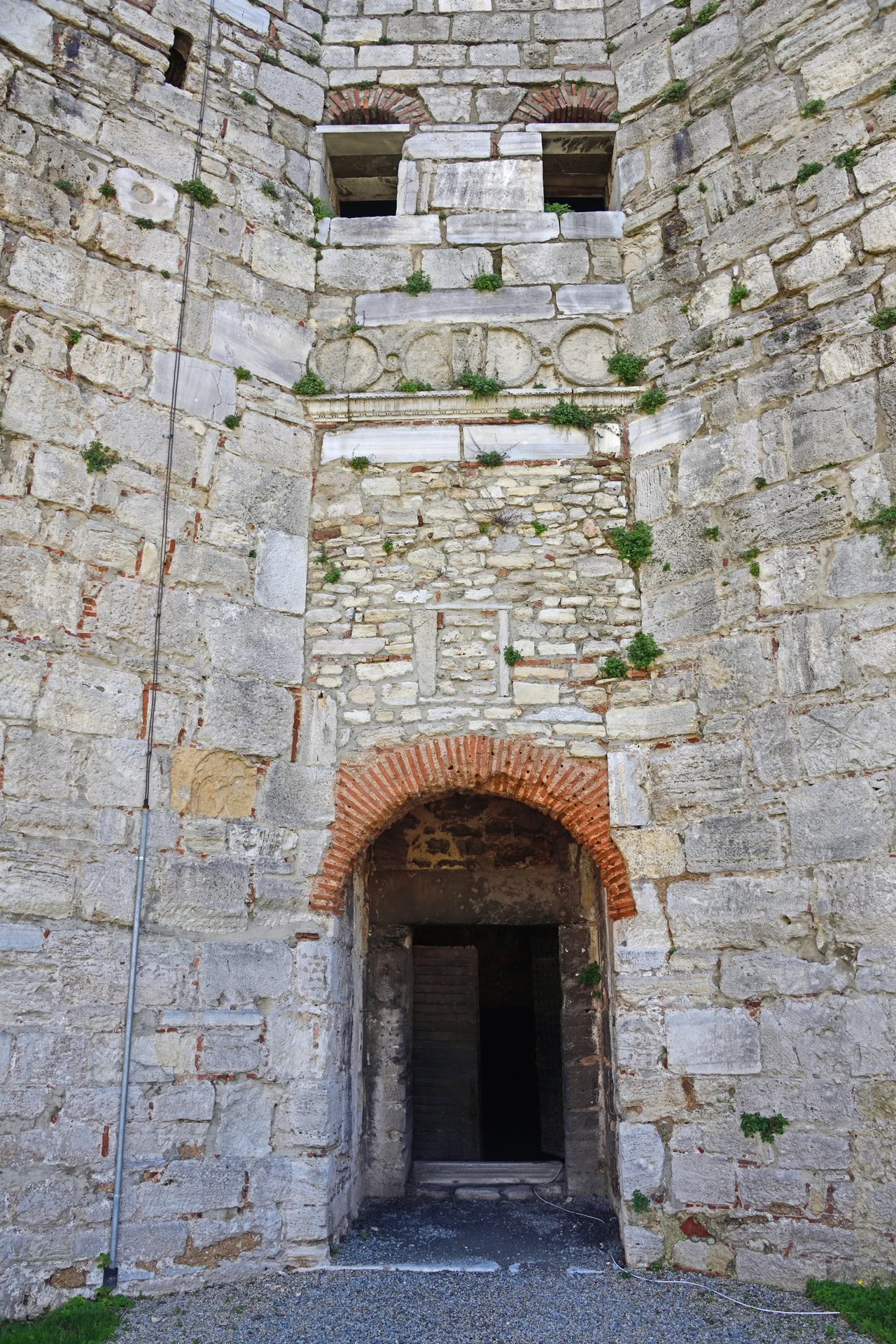

Yedikule Fortress
In 1622, a young man named Osman was murdered in the tower that bore his own title. He was seventeen years old, had reigned as Sultan of the Ottoman Empire for four years, and had tried to diminish the power of the Janissaries — the elite military corps that had made and unmade sultans for generations. The Janissaries moved against him, dethroned him, and brought him to Yedikule. He died there. The killing of a sitting sultan by his own soldiers was so shocking that it was referred to for centuries afterward simply as a crime. That act — the regicide of Osman II — did not define Yedikule's history, but it crystallized what the fortress had become: a place where power was exercised in its most brutal and absolute form, and where people who had once held authority arrived stripped of everything except the fact of their suffering.
Built on Roman Bones
Yedikule did not begin as a prison. When Sultan Mehmed II ordered its construction shortly after the Ottoman conquest of Constantinople in 1453, the fortress was conceived as a treasury — a secure vault for the empire's gold, silver, documents, and arms. The design absorbed and reused structures that were already ancient. Two marble towers that Mehmed II enclosed within the new complex had been built by the Roman emperors Theodosius I and Theodosius II as part of the triumphal Golden Gate, the ceremonial entrance through which Roman and later Byzantine emperors had passed in procession for over a thousand years. Mehmed added three new towers and walled in a section of the Theodosian land walls, creating a seven-tower enclosure that was impressive by any standard. Witnesses at the time described the fortress in terms they might use for a palace. Each tower was assigned specific contents from the imperial treasury. The compound was protected as a matter of the highest state priority.
The Prison Years
The role of treasury gave way, gradually and then systematically, to the role of prison. Ambassadors of nations at war with the Ottoman Porte were routinely confined at Yedikule when hostilities broke out — diplomatic practice of the era, however harsh by modern standards, treated envoys as hostages in times of conflict. In 1768, when the Ottomans declared war on Russia, Ambassador Aleksei Mikhailovich Obreskov and his entire embassy staff were imprisoned there. These men were not executed; they survived their confinement, though the experience of Yedikule — its towers, its damp cells, its isolation from everything except the sound of the city beyond the walls — was one that none of them sought. Others were less fortunate. David Megas Komnenos, the last Emperor of Trebizond, was executed at Yedikule in 1463, two years after Mehmed II had taken the city of Trabzon in 1461. King Simon I of Kartli, who had fought the Ottomans for years in the Caucasus and been captured during a battle, was held here from 1599 until his death in captivity in 1611. These were men of rank and history, but rank offered no protection once the gates of Yedikule closed.
Osman II and the Weight of a Name
The killing of Osman II in 1622 cast a shadow over the fortress's reputation that persisted for centuries. Osman had become sultan at fourteen and had tried to build a new kind of Ottoman army — one not dependent on the Janissaries, who by the early 17th century were as much a political force as a military one. His ambitions collided with their power. When they revolted, Osman was dethroned and brought to Yedikule. He was seventeen years old. What happened to him inside those walls — the manner of his death — was recorded with horror by contemporaries and later historians. He was the first Ottoman sultan ever killed by his own soldiers, and the event opened a period of political instability that haunted the empire for generations. To stand inside Yedikule today and know that history is to understand why the fortress occupies such a particular place in Turkish historical memory: it is not merely old, it is freighted with specific grief.
Witnesses Who Wrote It Down
Among the many people confined at Yedikule was the French writer and diplomat François Pouqueville, who was detained there from 1799 to 1801 during the Napoleonic Wars. Pouqueville was not a high-ranking political prisoner; he had been captured while traveling in Greece. But his time at Yedikule produced a detailed written record — published in his account of his travels through the Ottoman Empire — that preserved the physical reality of confinement there at the turn of the 19th century. He was one of many French prisoners held in the fortress during that period. Pyotr Andreyevich Tolstoy, the Russian statesman, spent years here between 1710 and 1714. Constantin Brâncoveanu, the Prince of Wallachia, arrived in 1714 and was executed. The list of the fortress's prisoners runs across nations, languages, and centuries, each name a compressed story of military defeat, diplomatic failure, or political misfortune. The last prisoner was released in 1837.
After the Cells Emptied
The outer gate of Yedikule was reopened in 1838, and the towers served as gunpowder magazines before the entire complex was transferred to become a museum in 1895. Today the fortress is open to visitors, and the views from its towers — across the Sea of Marmara, along the surviving stretches of the ancient land walls — are among the most historically resonant in Istanbul. An open-air theater has been built within the enclosure and hosts cultural festivals. A Muslim cemetery lies in front of the Golden Gate, now sealed with marble blocks. The gate that Roman emperors had processed through in triumph, that Ottoman sultans had used ceremonially, no longer opens. But the seven towers still stand, and the geraniums that visitors sometimes find growing in the cracks between the ancient stones are a small, stubborn insistence on life in a place that has seen so much of its ending.
From the Air
Yedikule Fortress lies at approximately 40.993°N, 28.923°E, at the southwestern corner of Istanbul's historic peninsula where the ancient Theodosian land walls once met the Sea of Marmara. From the air, the fortress is visually unmistakable: its seven stone towers form a tight polygon pressed against the surviving line of the Byzantine walls, with the blue water of the Marmara visible immediately to the south and west. At 2,000 feet, the full length of the land walls stretching northward from Yedikule toward Edirnekapı becomes legible — a remarkable sight. Nearest major airport is LTFM (Istanbul Airport), approximately 38 km to the northwest. The fortress stands roughly 14 km from the center of the old city.
Nearby Stories
- Kocaeli Peninsula 7.6 km away
- Second Battle of Çatalca 11 km away
- Istanbul's Rural Outskirts 14 km away
- MV Struma 20 km away
- HMAS AE2 36 km away
- Bursa 66 km away
- Sangarius Bridge 71 km away
- Januarius MacGahan 101 km away