
Yeni Valide Mosque
Emetullah Râbi'a Gülnûş Sultan had already outlasted most of the people who had underestimated her. She had come to the Ottoman court as a young woman from Crete, had become the mother of two sultans — Mustafa II and then Ahmed III — and had wielded the kind of influence at the palace that formal titles could not fully describe. She could determine which women entered the sultan's inner circle. She could intervene in administrative matters that were, by protocol, far outside her sphere. When she died in 1715, the mosque her son had built in her honor was already five years old, standing at the waterfront of Üsküdar on the Asian shore of Istanbul — the culmination of a tradition of royal women shaping the city's skyline through architectural patronage, and the last great mosque in that tradition.
The Son Who Built It
Sultan Ahmed III commissioned the Yeni Valide Mosque in his mother's honor, and construction ran from 1708 to 1710 under the administration of chief architect Kayserili Mehmed Ağa. Ahmed III was a sophisticated ruler whose reign is remembered partly for the Tulip Period — a flowering of Ottoman court culture characterized by gardens, festivities, the cultivation of European artistic influences, and a momentary relaxation of the severity that had defined earlier reigns. The mosque he built for his mother reflects this sensibility: it is opulent but not excessive, innovative in its structural details, and deeply attentive to the quality of its public spaces. The name translates simply as the New Valide Sultan Mosque — the new mosque of the sultan's mother — distinguishing it from earlier mosques built by valide sultans in Üsküdar. It was new. It was also, as it turned out, the last.
Architecture at the Water's Edge
The mosque stands south of Üsküdar's İskele Square, its two minarets visible from the Bosphorus ferries that connect the European and Asian shores of Istanbul. The building's square mass is covered by a central dome and four half-domes, in the tradition of the great classical Ottoman mosques, but with innovations that set it apart. The plan is a variant of the Rüstem Pasha Mosque, adapted with corner domes that give it a more classical character. The cross vault over the central opening of the entrance portico was an architectural invention first seen here — rather than the five domes typical of Ottoman mosque entrances, the Yeni Valide employs a cross vault over the central bay and cloister vaults over the sides. The dome proportions are notably higher and narrower than in earlier buildings, anticipating a trend in 18th-century Ottoman architecture. Inside, the decoration moves between stone muqarnas carvings with floral motifs and tiles in repetitive floral patterns, the visual richness accumulated but disciplined.
A Tomb Like a Bird Cage
Within the mosque's walled complex, the tomb of Gülnûş Sultan is among the most architecturally distinctive elements. It is open to the sky — an unusual feature, the tomb top latticed rather than solid domed — with bronze grilles set between columns and pointed arches that create a structure one historical account described as reminiscent of a birdcage. The choice of an open-topped tomb, allowing the sky to be present in the burial space, was exceptional. The bird houses set along the mosque's exterior facade reinforce this sensory attention to the natural world. These were not merely decorative. The Ottoman fondness for providing shelter for birds in architecture — incorporated into fountains, walls, and mosque facades — reflected a theological and aesthetic tradition of caring for animals as a form of piety. At the Yeni Valide, the birds are built into the building itself.
The Calligraphy and the Fountain
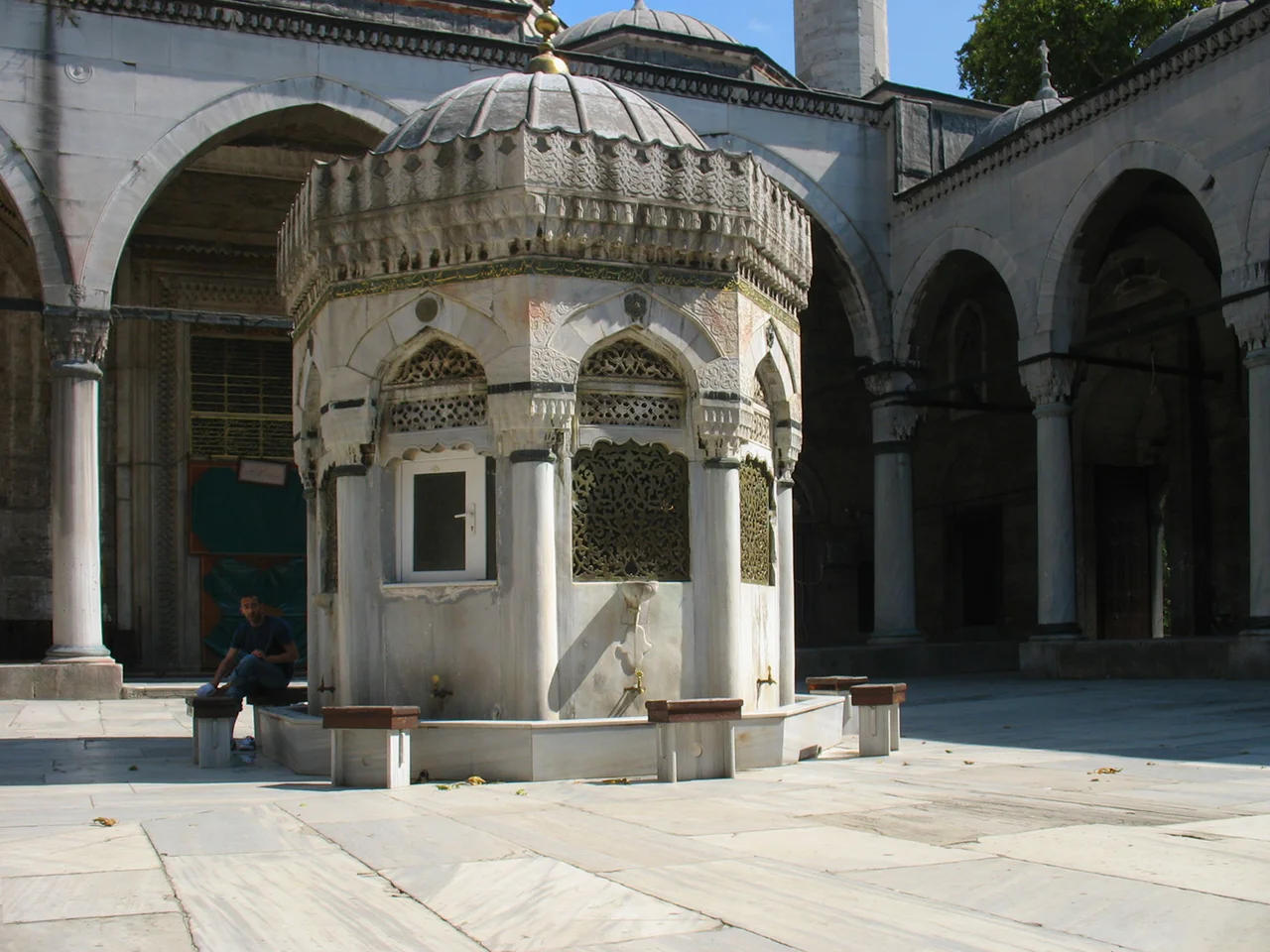
Inside the mosque, the calligraphic work is the achievement of Hezarfen Mehmet Efendi, whose Thuluth-script inscriptions on the interior of the domed ceiling quote from the Quran and invoke the names of the Prophet and Allah. The windows create a deliberate optical conversation: those beneath the domes are pointed, visually pushing the weight upward; those in the dome itself are rounded, pulling the dome down into the structure. The effect is a play of forces, of lightness and weight, made visible through the geometry of the openings. In the northeastern section, a public water fountain completed in 1709 occupies a prominent position. Made of marble, it is crowned with a large palmette arrangement reminiscent of the double-headed eagle — a symbol of imperial power and sovereignty. Nine feather-like forms spread at its base. The fountain was built to serve the community as well as to announce the sultan's presence in the neighborhood.
What Gülnûş Built in Her Name
The full külliye — the mosque complex — that Ahmed III built in his mother's honor was more than a place of worship. It included a soup kitchen, a market arcade, a primary school, a room for the mosque's timekeeper, an imperial pavilion, and a water fountain accessible to the public. These buildings were the social infrastructure of the neighborhood, built to demonstrate that Ottoman imperial women patronized not just architecture but community life. Gülnûş Sultan had, during her lifetime, been a significant patron in her own right. The mosque is her monument, but the complex around it is a statement about what it meant to hold power in the Ottoman system: it meant building things that outlasted you, things that people used every day, things that announced your presence in stone and marble for centuries after you were gone. The Yeni Valide Mosque has been doing that since 1710.
From the Air
The Yeni Valide Mosque stands at approximately 41.025°N, 29.015°E in Üsküdar on the Asian side of Istanbul, directly on the Bosphorus waterfront. Its two minarets are visible from the water and from aircraft approaching the Asian shore. The mosque is a short distance from the Üsküdar İskele ferry terminal, and the Bosphorus — the narrow strait connecting the Black Sea to the Sea of Marmara — lies immediately to the west. At 1,500 feet, the mosque complex is easily identifiable from its position at the water's edge, with the vast urban spread of Istanbul's Asian districts extending behind it. Nearest major airport is LTFJ (Sabiha Gökçen International Airport), approximately 25 km to the southeast.
Nearby Stories
- Kocaeli Peninsula 7.6 km away
- Second Battle of Çatalca 11 km away
- Istanbul's Rural Outskirts 14 km away
- MV Struma 20 km away
- HMAS AE2 36 km away
- Bursa 66 km away
- Sangarius Bridge 71 km away
- Januarius MacGahan 101 km away