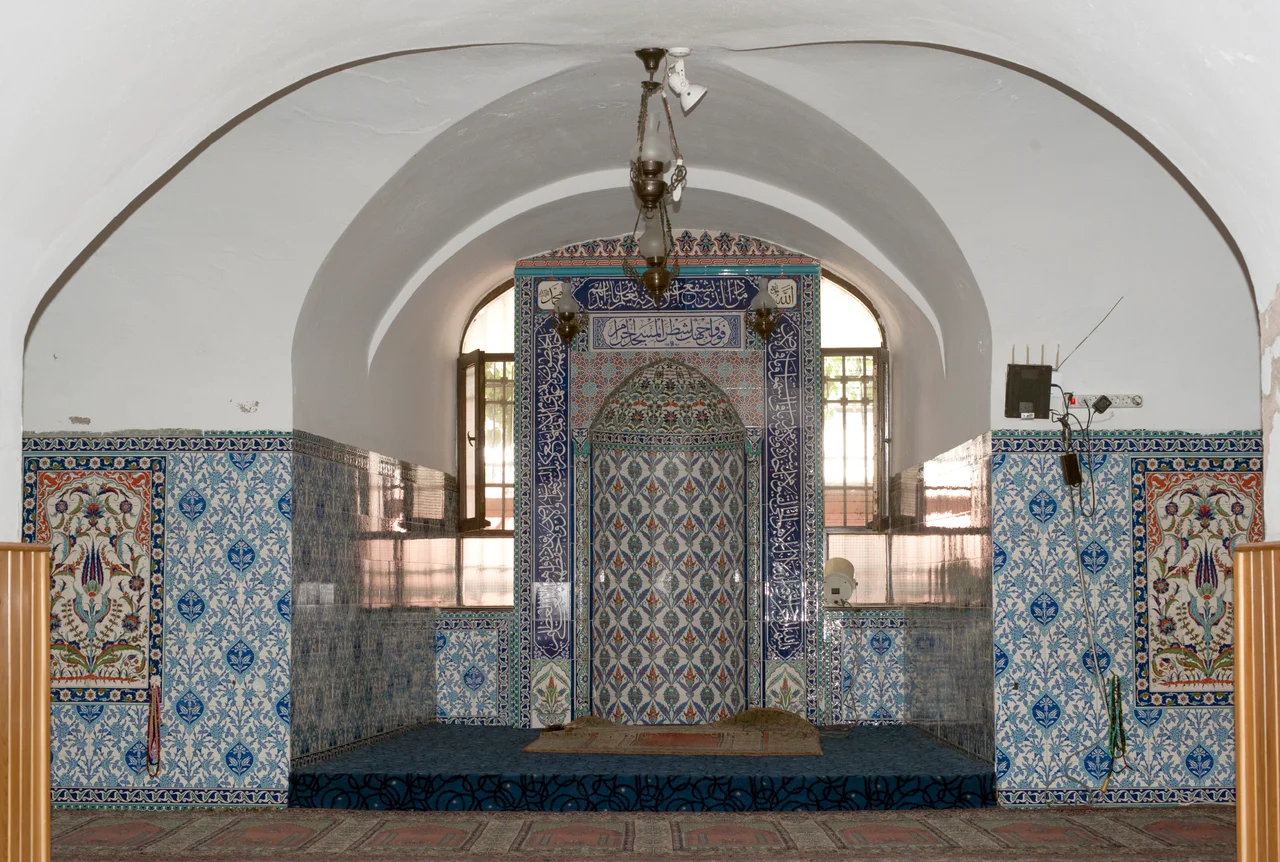

Yeraltı Mosque
You descend to pray at the Yeraltı Mosque. The name means simply "Underground Mosque," and the descent is literal: steps lead below street level into a space of low stone vaults, dim light, and the kind of compressed quiet that thick walls create. This is not a subterranean retreat by design — it is, rather, a former Byzantine fortress substructure that was converted to religious use, a place where the history of two civilizations occupies the same physical space simultaneously.
What the Vaults Were Before
The structure beneath Karaköy — the neighborhood at the base of the Galata Bridge on the Golden Horn's northern shore — served as the basement cellar of a Byzantine fortification. Exactly which fortress it belonged to remains a matter of scholarly discussion, but the building's bones are unmistakably Byzantine: heavy masonry, barrel-vaulted ceilings, proportions suited to storage and defense rather than worship. The mosque occupies this underground space wholesale, with its mihrab (prayer niche) and minbar (pulpit) installed within the existing vaulted chambers. It is sometimes called by another name — Kurşunlu Mahzen, meaning the "Lead-Sealed Vault" — a name that recalls the practice of sealing captured Umayyad warriors' belongings inside with molten lead.
Tombs and the Memory of Sacrifice
At the center of the mosque, accessible through a small doorway, lies the room that makes Yeraltı a place of pilgrimage as much as prayer. It contains cenotaphs — commemorative tombs — venerated as the resting places of early Muslim figures who, according to local tradition, died during the Arab attempts to capture Constantinople. The Arab sieges of Constantinople — the first in 674–678 under Caliph Mu'awiya I, the second in 717–718 under the Umayyad commander Maslama ibn Abd al-Malik — were among the most dramatic military campaigns of early Islamic history. Local tradition holds that soldiers captured during these sieges were brought here, and that some were tortured to death within these walls. The traditions around specific names involve complexities and discrepancies that historians have noted — for instance, the figures named in some accounts are known from other sources to have died in different places. What matters is the reverence itself: for generations of pilgrims, this underground space has been a place to remember those who died far from home in the service of their faith.
The Weight of the Air
Visiting the Yeraltı Mosque is an experience defined by the architecture as much as by intention. The low vaulted ceiling presses the space downward, creating an intimacy unusual for a mosque — most Islamic sacred architecture reaches upward, toward light and height. Here the effect is the reverse: devotion is contained, concentrated, turned inward. The hallways between chambers are narrow. The dome above the tombs, modest by the standards of Ottoman mosque architecture, feels proportionally large in the compressed space below it. Worshippers and visitors move through the rooms with a different kind of attention than they might bring to a soaring domed hall. The mosque remains an active place of worship, not a museum, and visitors are asked to observe the usual courtesies of any functioning mosque.
Karaköy Above, History Below
Emerge from the mosque and you are back in Karaköy, one of Istanbul's most energetic waterfront neighborhoods — ferries, fish restaurants, coffee shops, the constant traffic of the Galata Bridge. The contrast is part of what makes the Yeraltı Mosque worth seeking out. Istanbul has no shortage of spectacular mosques that announce themselves from a distance, their minarets visible for miles. This one asks you to look down rather than up, to descend rather than approach. In doing so, it offers something different: a encounter with accumulated history in a place that hasn't been smoothed into a tourist destination, where the Byzantine and Ottoman pasts share physical space with an active Muslim congregation continuing a tradition that stretches back, in this particular spot, for centuries.
From the Air
The Yeraltı Mosque sits at approximately 41.02°N, 28.98°E in the Karaköy district, immediately north of the Golden Horn at the base of the Galata Bridge. From the air at 2,000–4,000 feet, the Galata Bridge is the clearest landmark — a long span crossing the Golden Horn mouth, with Karaköy on its northern end. The Galata Tower rises visibly to the northeast. Istanbul Airport (LTFM) is approximately 30 km to the northwest. The mosque itself is below street level and not visible from the air, but the surrounding Karaköy waterfront is easy to identify.
Nearby Stories
- Kocaeli Peninsula 7.6 km away
- Second Battle of Çatalca 11 km away
- Istanbul's Rural Outskirts 14 km away
- MV Struma 20 km away
- HMAS AE2 36 km away
- Bursa 66 km away
- Sangarius Bridge 71 km away
- Januarius MacGahan 101 km away