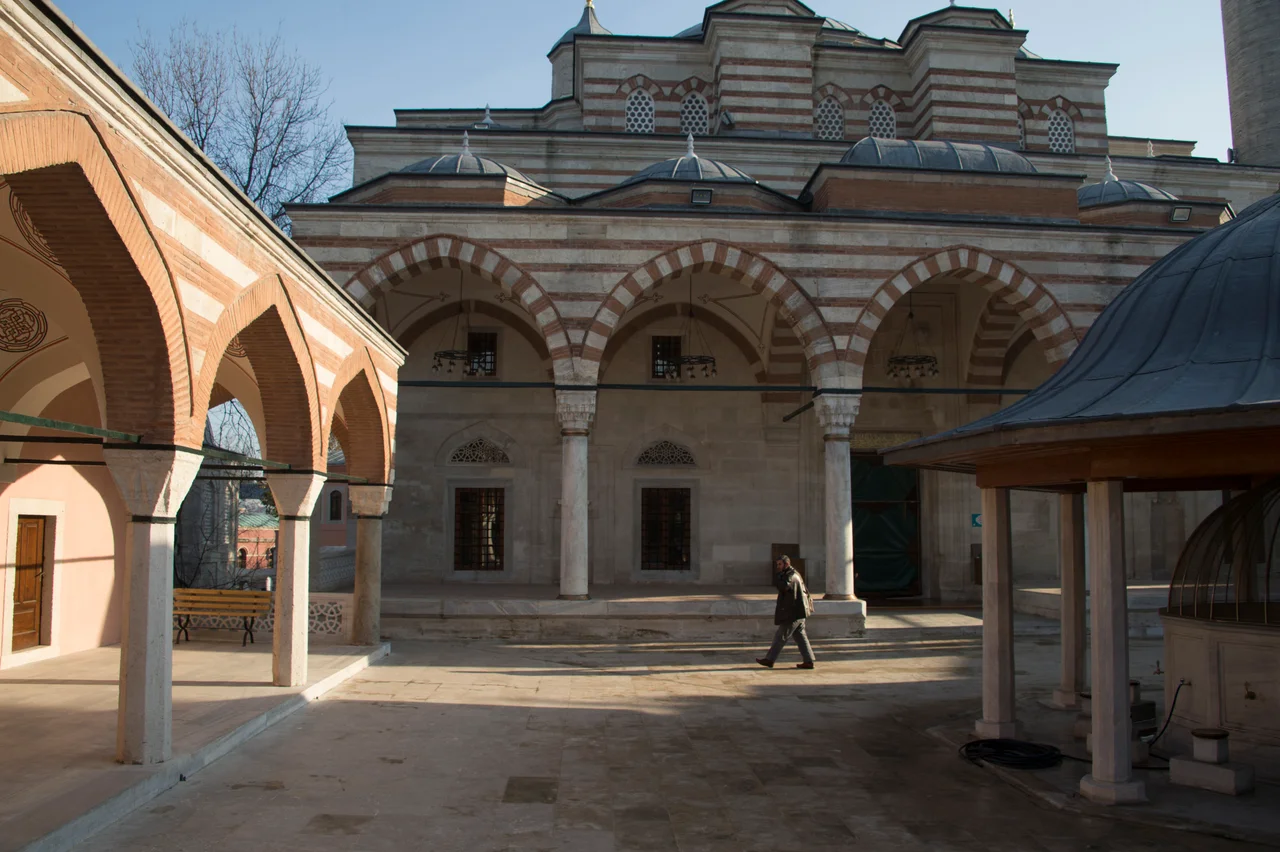

Zal Mahmud Pasha Mosque
The man who paid for this mosque had blood on his hands — literally. Zal Mahmud Pasha, a Bosnian-born vizier in the Ottoman court, had in 1553 carried out the execution of Şehzade Mustafa, Suleiman the Magnificent's eldest son, by strangulation on the sultan's orders. It was a palace killing, the kind that punctuated Ottoman dynastic politics, and it made Zal Mahmud Pasha permanently useful to power and permanently suspect in public memory. Decades later, he and his wife Şah Sultan — a daughter of Sultan Selim II — jointly endowed a mosque in Eyüp. They gave the commission to the greatest architect of their age.
A Commission That Outlasted Its Patrons
Building work on the Zal Mahmud Pasha Mosque began in 1577, but neither of its founders lived to see it completed. Zal Mahmud Pasha and Şah Sultan both died in 1580, the same year. The architect Mimar Sinan — already legendary, already deep in the final chapter of a career that had produced the Süleymaniye Mosque and Selimiye Mosque in Edirne — continued the project. Sinan himself died in 1588, two years before the mosque was finally completed in 1590. The building thus outlasted both the people who commissioned it and the man who designed it, finished by craftsmen carrying forward the master's plans. That completion date, 1590, makes it one of the final works associated with Sinan's workshop.
The Tiles Around the Mihrab
Architecture tells its own version of a building's story, independent of the human drama behind it. Inside the Zal Mahmud Pasha Mosque, the most distinctive decorative feature is the border of Iznik tiles surrounding the mihrab — the niche in the wall indicating the direction of Mecca. Iznik, a city in northwestern Anatolia, produced the finest ceramic tiles in the Ottoman world during the 16th century, their blue-and-white and polychrome glazes achieving a depth and clarity that craftsmen in later centuries struggled to replicate. The tiles at Zal Mahmud Pasha Mosque are a characteristic Sinan touch: not ostentatious, but precise, the decoration integrated into the architecture rather than applied over it.
Eyüp's Sacred Ground
The mosque's location in Eyüp matters. This district at the western end of the Golden Horn is among the most sacred neighborhoods in Istanbul — home to the Eyüp Sultan Mosque, built over the tomb of Abu Ayyub al-Ansari, the standard-bearer of the Prophet Muhammad, who died during the Arab siege of Constantinople in the 7th century. Eyüp has been a place of pilgrimage and devotion for centuries, and new mosques built here carried a particular weight of religious significance. That Şah Sultan and Zal Mahmud Pasha chose Eyüp for their foundation suggests an aspiration toward spiritual rehabilitation as much as worldly commemoration — a large, prominent complex in a neighborhood thick with sanctity.
What Remains
The mosque stands today in Eyüp, part of a külliye — the Ottoman term for a mosque complex that typically included additional institutions such as a school, a hospice, or a tomb. The türbe (mausoleum) associated with Zal Mahmud Pasha survives alongside the mosque. The complex sits on a hill overlooking the Golden Horn, with views across the water toward the old city. Visitors who make the journey to Eyüp — many come primarily for the Eyüp Sultan Mosque nearby — find in the Zal Mahmud Pasha Mosque a quieter Sinan work, less visited than the famous imperial mosques on the historic peninsula but no less carefully made. The building carries its complicated history without advertising it.
From the Air
The Zal Mahmud Pasha Mosque stands at approximately 41.04°N, 28.94°E in the Eyüp district, on the western shore of the Golden Horn. From the air at 3,000–5,000 feet, the Golden Horn is visible as the curved inlet north of the historic peninsula; Eyüp lies at its far western end. The mosque sits on elevated ground above the waterfront. Istanbul Airport (LTFM) is approximately 25 km to the northwest, making Eyüp one of the closer historic districts to the airport. The Eyüp Sultan Mosque complex nearby provides an additional landmark.
Nearby Stories
- Kocaeli Peninsula 7.6 km away
- Second Battle of Çatalca 11 km away
- Istanbul's Rural Outskirts 14 km away
- MV Struma 20 km away
- HMAS AE2 36 km away
- Bursa 66 km away
- Sangarius Bridge 71 km away
- Januarius MacGahan 101 km away