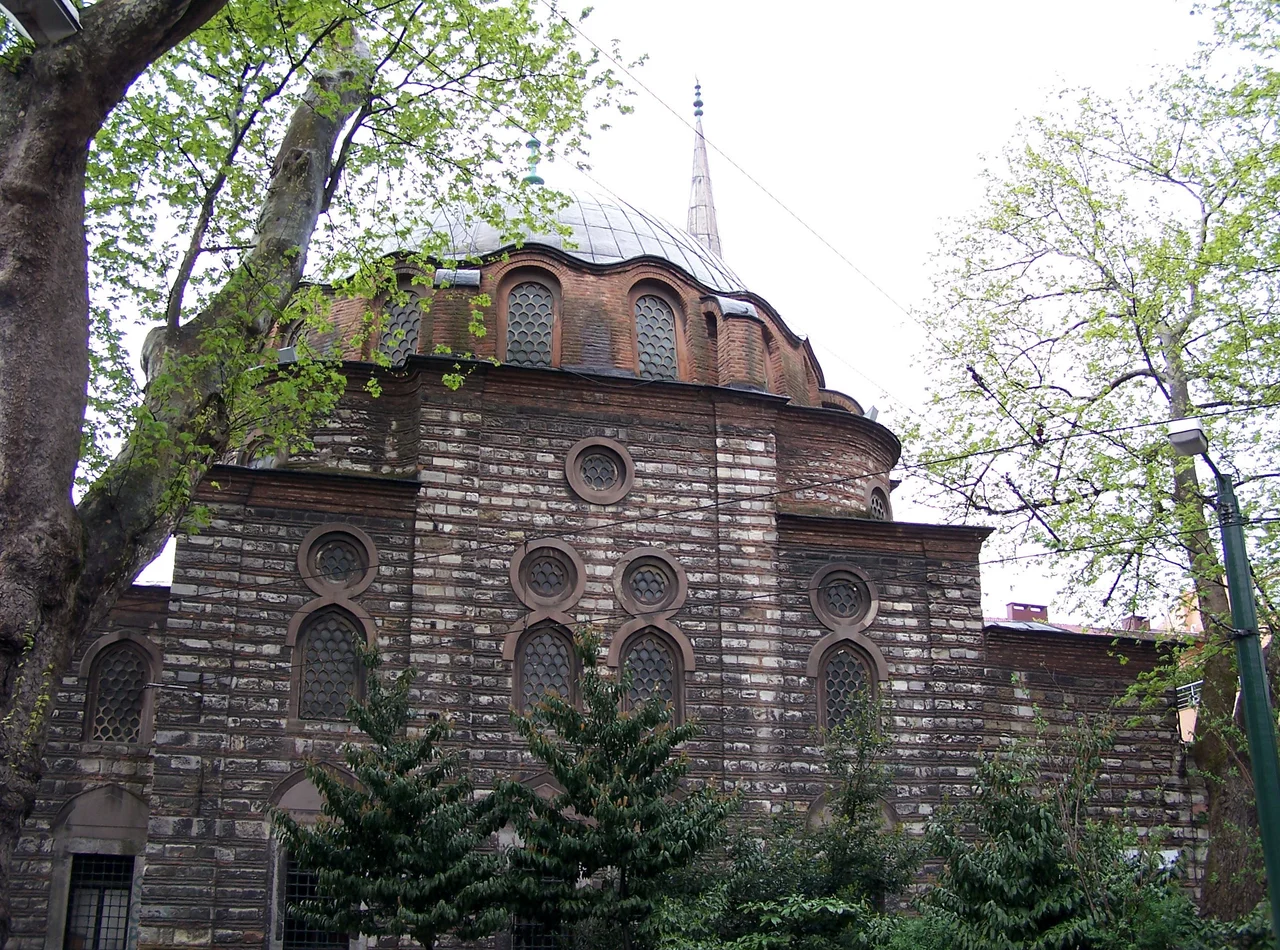

Zeynep Sultan Mosque
Passengers on the heritage tram that runs along Alemdar Caddesi pass it without always knowing what they are looking at. The Zeynep Sultan Mosque sits across from Gülhane Park, a short walk from the Hagia Sophia, its stone facade evoking Byzantine churches in a way that makes it feel older than it is. Built in 1769, it is actually an 18th-century Ottoman building — but its architect, Mehmet Tahir Ağa, used materials and proportions that deliberately called back to an earlier Christian architectural tradition. In a city full of mosques, this one is quietly eccentric.
Zeynep Sultan and Her Commission
Zeynep Sultan was a daughter of Sultan Ahmed III, one of the most culturally ambitious rulers of the 18th-century Ottoman court. Her father oversaw the so-called Tulip Era, a period of artistic flourishing and engagement with European aesthetics. Zeynep Sultan commissioned this mosque herself, choosing Mehmet Tahir Ağa, the same architect who had designed the Ayazma Mosque in Üsküdar. The building completed in 1769 stands as a personal foundation — a sultana's act of piety and patronage, modest in scale compared to the great imperial mosques but precise in its ambitions. The mosque has served the neighborhood continuously since its construction.
Why It Looks the Way It Does
The Zeynep Sultan Mosque's evocation of Byzantine church architecture is not accidental. Mehmet Tahir Ağa chose materials and forms that consciously referenced the older Christian buildings that surrounded this part of the city — walls thickened in particular ways, stonework handled differently from the prevailing Ottoman aesthetic. The result is a building that reads as genuinely hybrid, occupying an architectural space between two traditions that coexisted in Istanbul for centuries. Visitors expecting the pointed arches and slender minarets of classical Ottoman style find instead something quieter and more ambiguous, a mosque that seems in dialogue with the church-turned-mosque that stands a few hundred meters away.
A Courtyard of Graves
The hazîre — the cemetery enclosure attached to the mosque — holds several notable burials. Alemdar Mustafa Pasha, an Ottoman military figure who served as Grand Vizier under Sultan Mahmud II in the early 19th century and who died in 1808 under dramatic circumstances, is buried here. The grave of Melek Mehmet Pasha, who served as Grand Vizier under Selim III between 1792 and 1794 and who was Zeynep Sultan's second husband, is also in the hazîre. Zeynep Sultan herself has not yet found her permanent resting place in the mosque's burial ground — as of the most recent accounts, road construction displaced her remains from the cellar, and they await the completion of a new tomb. Even in death, the histories of the people who built and used this mosque remain unresolved.
The World Just Outside
The mosque's location gives it a particular kind of visibility. Alemdar Caddesi is one of the main arteries connecting Sultanahmet — the dense historic core with the Blue Mosque and Hagia Sophia — to the Sirkeci neighborhood and the waterfront. Trams pass constantly. Gülhane Park, one of Istanbul's largest urban green spaces, spreads across the street. The Topkapi Palace walls loom nearby. For a building of modest size, the Zeynep Sultan Mosque occupies conspicuous ground, the kind of location that ensures it will be noticed even by visitors whose attention is primarily on the larger monuments around it. The fountain in front of the mosque, originally part of Sultan Abdul-Hamid I's külliye, was moved here in the 1920s — another layer of history folded into a small, busy corner of the old city.
From the Air
The Zeynep Sultan Mosque stands at approximately 41.01°N, 28.98°E on Alemdar Caddesi in Fatih, directly across from Gülhane Park and a short distance northeast of the Hagia Sophia. From the air at 2,000–4,000 feet, the historic peninsula tip is a clear landmark — the Hagia Sophia's massive dome and four minarets are unmistakable, with Topkapi Palace and its tree-filled courtyards immediately adjacent to the north. Istanbul Airport (LTFM) lies approximately 35 km to the northwest. The Bosphorus strait is visible to the east, and the Golden Horn inlet appears to the north.
Nearby Stories
- Kocaeli Peninsula 7.6 km away
- Second Battle of Çatalca 11 km away
- Istanbul's Rural Outskirts 14 km away
- MV Struma 20 km away
- HMAS AE2 36 km away
- Bursa 66 km away
- Sangarius Bridge 71 km away
- Januarius MacGahan 101 km away