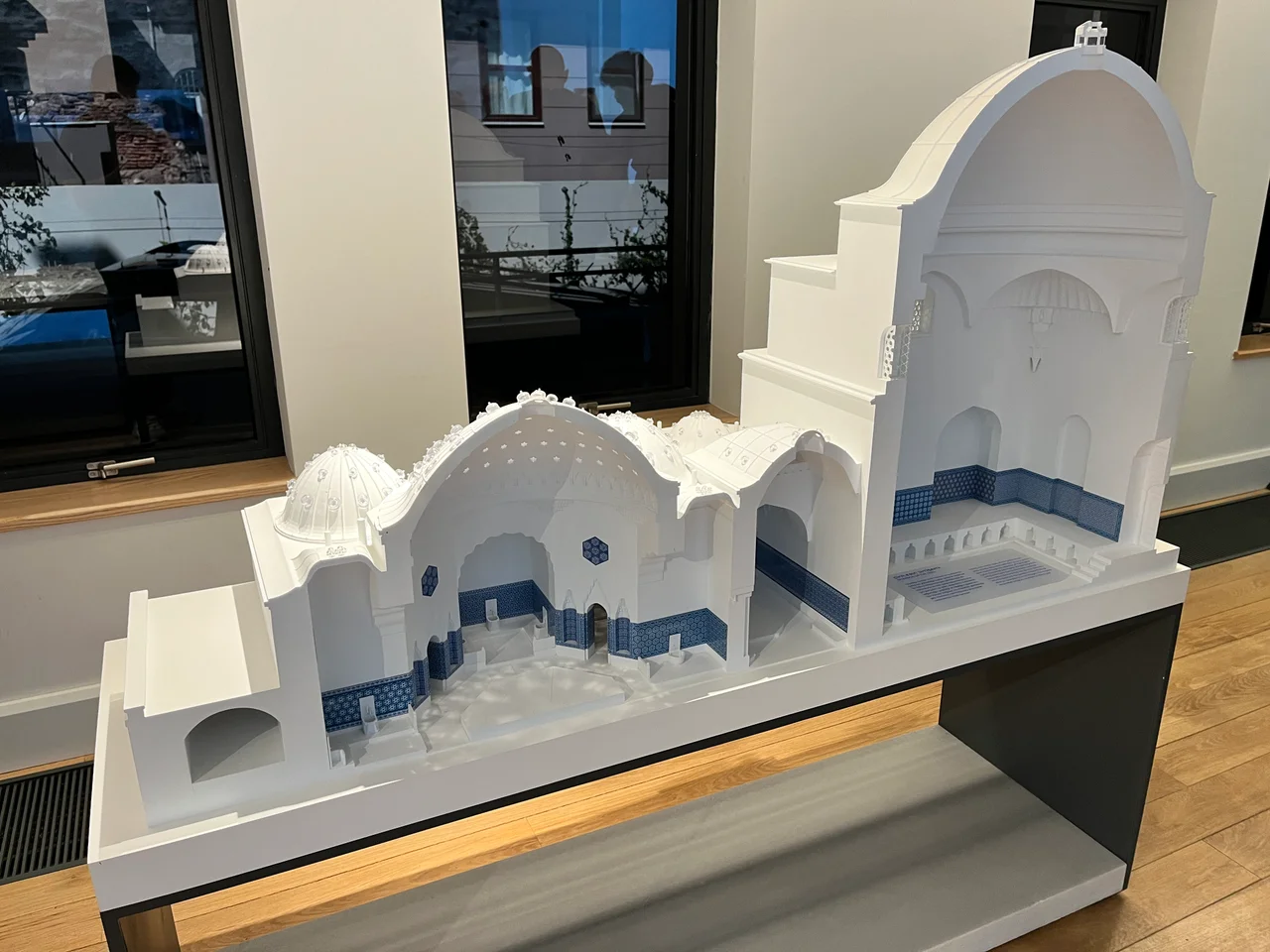

Zeyrek Çinili Hamam
The tiles scattered across European museum collections — London's Victoria and Albert Museum among them — are the most famous thing about the Zeyrek Çinili Hamam, and they are also the most poignant. A Parisian antique dealer acquired them after earthquakes and fires damaged the bathhouse during the 18th century, and they have been in Europe ever since. The bath itself sat derelict for decades, stripped of the decoration that gave it its name: çinili means "tiled" in Turkish. After a 13-year restoration completed in the early 2020s, the hamam is open again — and the fragments that were found during excavation are now on display in a museum built right next door.
Who Built It, and Why
The Zeyrek Çinili Hamam was commissioned between 1540 and 1546 by Barbaros Hayreddin Pasha, the grand admiral of the Ottoman navy — the man known to Europeans as Barbarossa, one of the most formidable naval commanders of the 16th century. Hayreddin Pasha had transformed Ottoman sea power in the Mediterranean, defeating Habsburg fleets and establishing the empire's dominance across the inland sea. His patronage of the hamam was an act of civic generosity typical of powerful Ottoman figures: endowing public institutions was a form of piety and legacy-building. For the design, he secured Mimar Sinan — the chief imperial architect who was then at the height of his powers — and Sinan built the bathhouse atop an earlier Byzantine-era cistern, integrating the older structure into the foundations.
The Blue-and-White Interior
What made this hamam extraordinary in its prime was the tilework. Iznik, a city in northwestern Anatolia, produced the finest ceramic tiles in the Ottoman world during the 16th century, and the Zeyrek Çinili Hamam was adorned with their characteristic blue-and-white glazed panels. The color of 16th-century Iznik blue is difficult to describe to someone who has only seen later imitations: it is saturated without being garish, its depth achieved through a particular formulation of cobalt oxide and a lead glaze that craftsmen in later periods could not replicate with the same consistency. When earthquakes struck and fires swept through Istanbul during the 18th century, the tiles were damaged. They then left Istanbul in pieces, acquired by an antique dealer, and dispersed into European collections where they remain today.
Thirteen Years of Restoration
After lying unused for decades, the hamam underwent a 13-year restoration before reopening in September of a recent year. Restoration projects of this scale — in historic buildings with complex structural histories, built over older structures, stripped of their original decorative surfaces — require patient archaeological and conservation work alongside the physical reconstruction. During the excavations carried out as part of the restoration, fragments of the original Iznik tiles were uncovered in situ. Rather than attempt a full reconstruction of the tilework, the project's designers chose to display what was found as it was found: the adjacent museum presents these fragments alongside insights into the hamam's ingenious heating system, its water journey from source to basin, and the material culture of Ottoman bath life. In 2024, TIME magazine recognized the Zeyrek Çinili Hamam as one of its World's Greatest Places.
What a Hamam Was
To understand why Zeyrek Çinili Hamam matters, it helps to understand what a hamam was in Ottoman society. These were not merely bathing facilities — they were social institutions, places of gathering, grooming, conversation, and ritual. The architecture was engineered around the experience: an entrance hall for undressing and resting, a warm transitional room, and the hot room at the center where water heated by an ingenious underfloor system turned the air thick and the stone floors warm underfoot. The star-shaped skylights cut into the domes let in shafts of light without compromising the thermal environment. Visiting the restored Zeyrek Çinili Hamam today means engaging with this full system, not just the building's shell — a living encounter with Ottoman daily life in one of Istanbul's oldest neighborhoods.
From the Air
The Zeyrek Çinili Hamam stands at approximately 41.02°N, 28.96°E in the Zeyrek district of Fatih, in the historic peninsula's northern interior. From the air at 3,000–5,000 feet, the Zeyrek district lies just west of the Atatürk Bridge crossing the Golden Horn, recognizable by the prominent bulk of the Church of the Pantocrator (now Zeyrek Mosque) nearby. Istanbul Airport (LTFM) lies approximately 30 km to the northwest. The historic peninsula tip with the Hagia Sophia and Topkapi Palace is visible to the southeast.
Nearby Stories
- Kocaeli Peninsula 7.6 km away
- Second Battle of Çatalca 11 km away
- Istanbul's Rural Outskirts 14 km away
- MV Struma 20 km away
- HMAS AE2 36 km away
- Bursa 66 km away
- Sangarius Bridge 71 km away
- Januarius MacGahan 101 km away