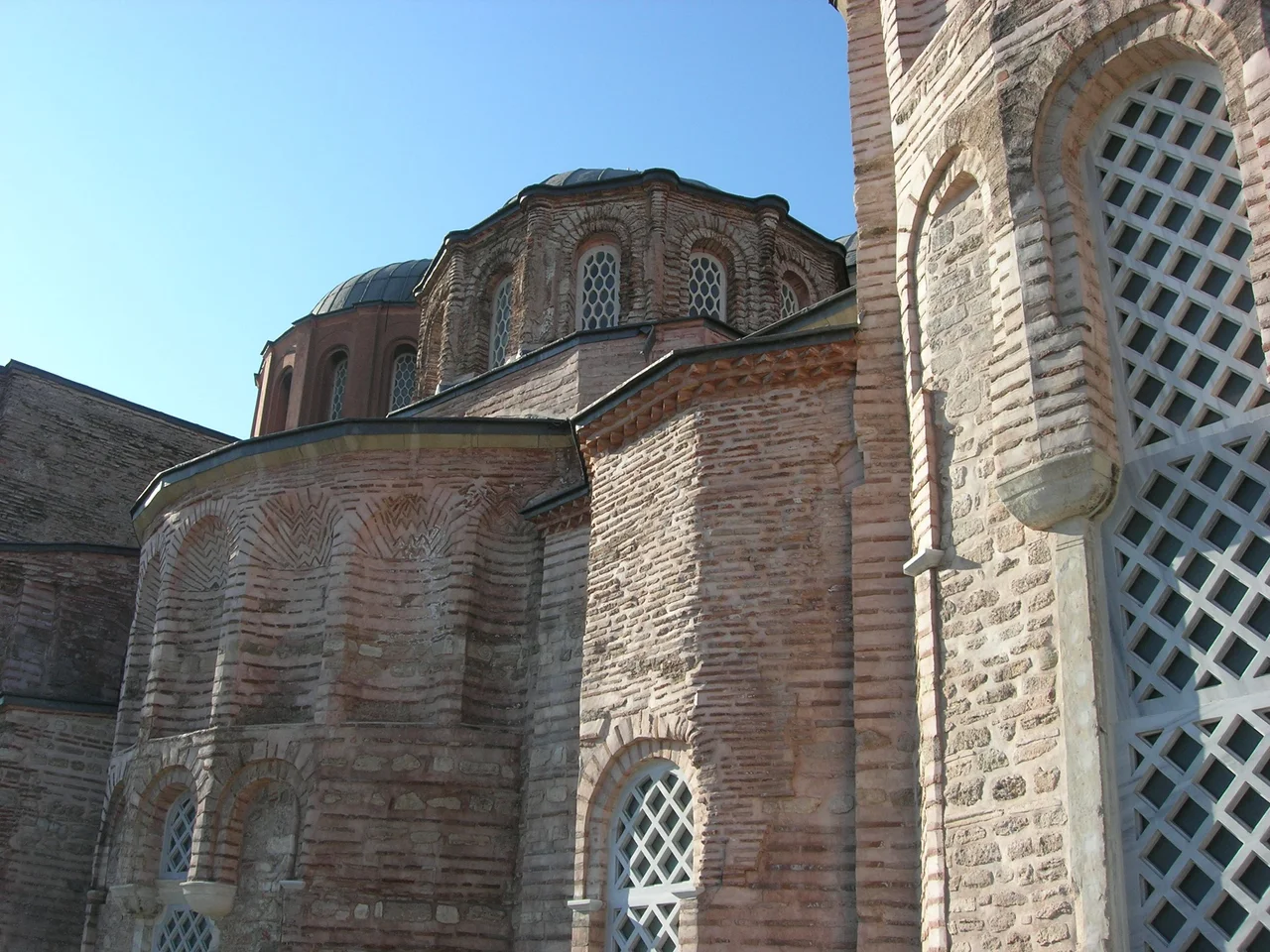

Zeyrek Mosque
In 1204, soldiers of the Fourth Crusade sacked Constantinople and stripped the Monastery of the Pantokrator of its treasures. Some of the looted Byzantine enamel panels ended up incorporated into the Pala d'Oro — a jeweled altarpiece already in Saint Mark's Basilica in Venice, where it still glitters today, more than eight centuries later. The monks were gone, the imperial tombs desecrated, the library scattered. Yet the monastery itself survived. It survived the Crusaders, the restoration of Byzantine rule, the fall of Constantinople in 1453, and centuries as a mosque, a medrese, and eventually a ruin slowly crumbling above the Golden Horn. Today, after a long and sometimes controversial restoration, the Zeyrek Mosque stands as the second-largest surviving Byzantine religious edifice in Istanbul — a place that has held more history than almost any building on Earth.
An Empress Builds, an Emperor Mourns
Between 1118 and 1124, the Byzantine Empress Irene of Hungary raised a monastery on this hilltop dedicated to Christ Pantokrator — Christ the Omnipotent. The complex was substantial: a church serving as the katholikon, or main church; a library; and a hospital, making it both a spiritual and a medical institution in a city that still prided itself on Roman sophistication. After Irene's death, her husband Emperor John II Komnenos built a second church to the north, dedicated to the Theotokos Eleousa — the Merciful Mother of God. This northern church was open to the general population, served by lay clergy, and distinguished by something no other Byzantine church could claim: it became the imperial mausoleum, the heroon, of the Komnenos and Palaiologos dynasties. Generations of emperors and empresses were laid to rest here. The physical weight of the Byzantine state rested, literally, in its walls.
Crusaders, Monks, and the Last Patriarch
The Latin occupation after 1204 turned the monastery into a palace for the Latin Emperor Baldwin. An icon of the Theotokos Hodegetria — one of the most venerated images in Christendom — was housed within its walls during this strange interregnum, when Venetian priests replaced Greek monks and the language of prayer shifted from Greek to Latin. After the Palaiologan restoration of Byzantine rule, the monastery returned to Orthodox use. Its most consequential resident was Gennadius II Scholarius, a scholar and theologian who had been a monk at the Pantokrator before the Ottoman conquest. When Sultan Mehmed II took Constantinople in 1453, he chose Gennadius not just to survive but to lead: the scholar left the Pantokrator to become the first Patriarch of Constantinople under Ottoman rule, beginning the long accommodation between the Greek Orthodox Church and the new empire.
The Architecture of Deep Time
The mosque's bones are unmistakably Byzantine. The masonry uses a technique characteristic of the Middle Byzantine period — the recessed brick method, in which alternate courses of bricks are set back from the wall face in deep mortar beds, the mortar layers roughly three times thicker than the bricks themselves. The result is a wall that reads as striped, almost layered, as if the building itself is displaying its age in cross-section. Both the south and north churches are cross-shaped in plan, topped by central domes, with polygonal apses of seven sides — one more than the five typical of the preceding century. The apses feature triple lancet windows flanked by niches. As late as the 18th century, visitors reported mosaic images of the apostles and scenes from the life of Christ still visible on the walls, though defaced. The dog's-tooth and triangle frieze running along the eaves of the north church is perhaps the most distinctive ornamental detail still legible from the street below.
Named for a Scholar, Saved by Controversy
Shortly after the fall of Constantinople in 1453, the main church became a mosque. The Ottomans named it after Molla Zeyrek, a scholar who taught in the adjoining medrese — giving both the building and the surrounding neighborhood the name they carry today. The medrese eventually vanished, but the mosque endured, slowly deteriorating. By the early 21st century the edifice had become dangerously ruinous, earning a place on UNESCO's watchlist of endangered monuments. The restoration that followed was extensive — and not without critics who questioned choices made about materials and method. Still, it is done. The mosque is open again for prayer, its fine opus sectile pavement concealed beneath carpet in the manner of many converted Byzantine buildings, but its domes intact, its walls consolidated, its survival assured for at least another generation.
A View Above the Golden Horn
The Pantokrator complex crowns a steep hill in the Fatih district, and its position was never accidental. Byzantine architects placed their most important institutions where they could be seen — and where those inside could see everything. From the terrace of the adjoining Zeyrekhane restaurant, housed in a restored Ottoman konak to the east, the Golden Horn opens below in a long sweep of water, with the mosques and minarets of the old city arrayed against the sky. Less than a kilometer to the southeast stands the Eski Imaret Mosque, another Byzantine church repurposed after 1453. The neighborhood is studded with survivors. But none carries quite the weight of the Pantokrator — none served as imperial mausoleum, monastic library, crusader palace, and neighborhood mosque all in one. Each identity was laid over the last, and the walls absorbed them all.
From the Air
The Zeyrek Mosque sits at approximately 41.0197°N, 28.9572°E on a prominent hill in the Fatih district of European Istanbul, overlooking the Golden Horn inlet. From the air at 2,000–4,000 feet, the complex is identifiable by its cluster of Byzantine domes amid the rooftops of a densely built Ottoman neighborhood. The nearest major airport is Istanbul Airport (LTFM), approximately 35 km to the northwest. On approach from the west, the Golden Horn is a clear navigational reference — the mosque crowns the ridge to the south of it. The Aqueduct of Valens, built in 375 CE, is visible as a long stone arch cutting through the urban fabric just to the southwest.
Nearby Stories
- Kocaeli Peninsula 7.6 km away
- Second Battle of Çatalca 11 km away
- Istanbul's Rural Outskirts 14 km away
- MV Struma 20 km away
- HMAS AE2 36 km away
- Bursa 66 km away
- Sangarius Bridge 71 km away
- Januarius MacGahan 101 km away