
Zeyrek
The neighborhood takes its name from a scholar. Molla Zeyrek taught in the medrese attached to the old Byzantine monastery on the hill, and when the Ottomans converted the monastery to a mosque after 1453, the building and then the whole district absorbed his name. That continuity — Byzantine structure, Ottoman name, modern UNESCO designation — is characteristic of Zeyrek. Very little here arrives without carrying something older inside it. The streets are steep and irregular, the wooden houses lean toward each other across narrow lanes, and the Aqueduct of Valens, constructed in 375 CE, cuts through the neighborhood below like a stone wall that the city simply built around for sixteen centuries.
The Hill Above the Golden Horn
Zeyrek occupies a hilly wedge of the Fatih district, bounded to the south by the wide rush of Atatürk Bulvarı — that arterial road pushed through the historic urban fabric by the French town planner Henri Prost in the 1950s — and to the north by the quieter Fatih neighborhood. The population stood at 12,863 in the 2022 census. It is, by most measures, a poor neighborhood, but poverty has paradoxically protected it: the area was never wealthy enough to attract the kind of wholesale redevelopment that erased comparable historic fabrics elsewhere in Istanbul. What survived is genuine. The centre of Zeyrek is inscribed as part of the Historic Areas of Istanbul UNESCO World Heritage Site, and some of its old wooden houses were carefully restored in the early 21st century, their unpainted timber facades and overhanging upper floors now maintained as a living record of Ottoman domestic architecture.
Mosque, Cistern, Aqueduct
The Zeyrek Mosque is the neighborhood's dominant monument — a Byzantine complex of two churches and a funerary chapel, built for the Komnenian dynasty beginning in 1118 and converted to a mosque after the Ottoman conquest of 1453. Its opus sectile floor, laid in cut marble, lies hidden beneath carpet; its domes are intact. Beneath the mosque, down on Atatürk Bulvarı itself, a large Byzantine cistern with arched niches along its facade has been restored and opened to visitors. Nearby, the buildings of the Social Security Institution (SSK) designed by architect Sedad Hakkı Eldem represent a 20th-century contribution that earned the Aga Khan Award for Architecture in 1986 — proof that even modernist public architecture could find a place in this ancient streetscape without dishonoring it. The Aqueduct of Valens, built with stones quarried from ancient Chalcedon (the site that is now Kadıköy on the Asian shore), once carried water from Thrace across the city. Fourteen centuries after its construction, the aqueduct still frames the western approaches to Zeyrek.
Little Siirt: The Bazaar Quarter
To the west of the mosque sits a rectangular market area around the Hüsambey Tezgahçılar Mosque, traditionally known as the Kadınlar Pazarı — Women's Bazaar — and now more commonly called Fatih Pazarı or, by Istanbullus who know it best, Little Siirt. The name comes from the cuisine: the restaurants and food shops here serve the cooking of Siirt province in southeastern Turkey, and the specialties are specific and memorable. Büryan kebab is lamb slow-cooked in a sealed pit oven, tender enough to pull apart with no resistance. Perde pilav is more theatrical — chicken, grapes, and almonds baked inside a fez-shaped pastry case, so that what arrives at the table looks more like a hat than a dish. These are flavors of a different Turkey, brought to Istanbul by migrants and now firmly embedded in the neighborhood's daily life. The bazaar is also pressed up against the Aqueduct of Valens, so you eat southeastern lamb under Roman arches.
Wooden Houses and What They Remember
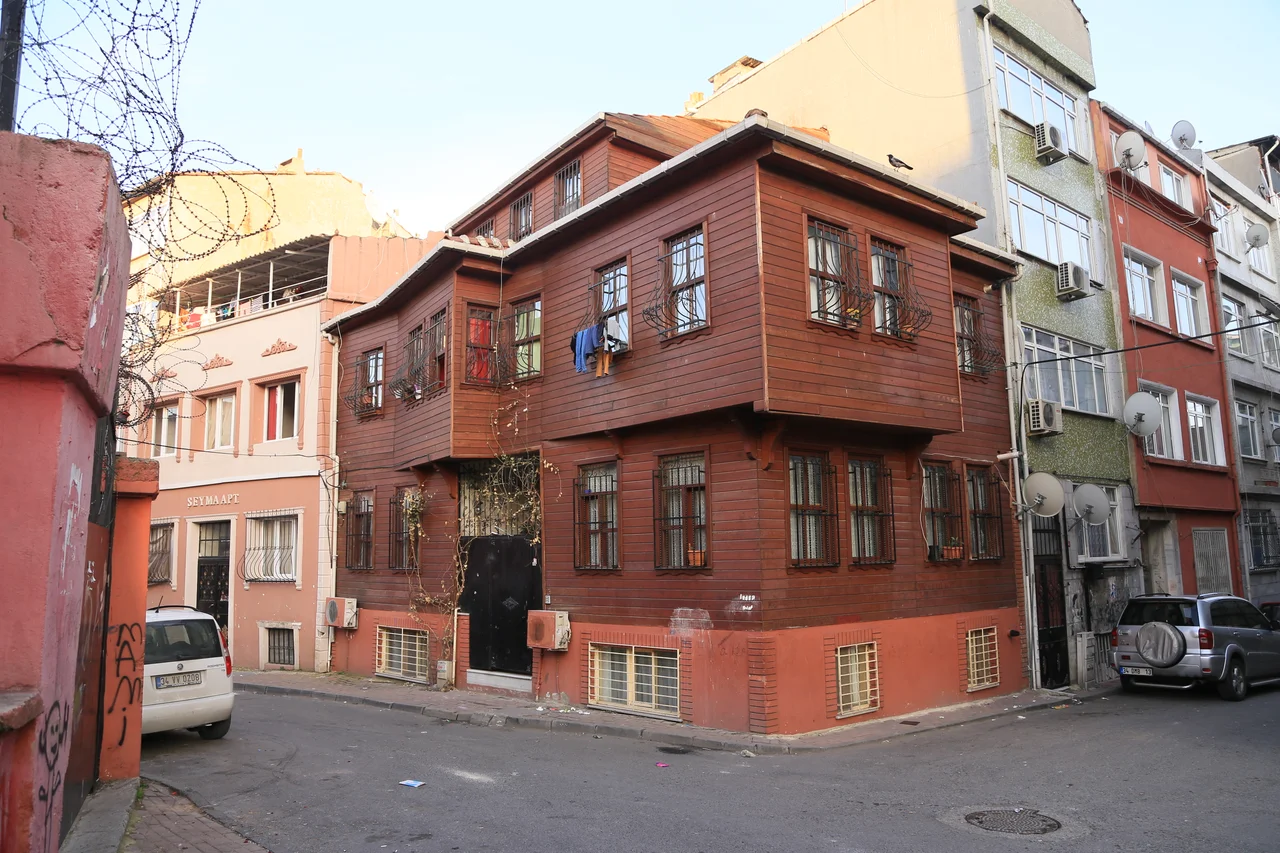
Istanbul has lost most of its traditional wooden residential architecture to fire, neglect, and real-estate development. Zeyrek is one of the places where a recognizable stock of it remains. The houses are two and three stories, their upper floors projecting over the street on carved wooden brackets, their facades weathered to the grey of old timber. Some have been restored; others are still in the slow process of deterioration that the UNESCO designation is meant to arrest. Walking the lanes above the mosque — Ibadethane Sokak and the streets off it — the city feels startlingly old and quiet. The Gazanfer Agha Medrese, pressed against the aqueduct at the neighborhood's edge, was built for the last Chief of the White Eunuchs of Topkapı Palace at the very end of the 16th century. It once housed Istanbul's Museum of Cartoons and Humour, which relocated to Beyoğlu in 2010. In Zeyrek, even the repurposed buildings have histories dense enough to fill several other cities.
From the Air
Zeyrek lies at approximately 41.0197°N, 28.9572°E in the Fatih district of European Istanbul, on a ridge overlooking the southern shore of the Golden Horn. At 1,500–3,000 feet the Aqueduct of Valens is clearly visible as a long stone arcade cutting across the urban grid — a reliable navigational landmark. The Zeyrek Mosque's cluster of Byzantine domes marks the neighborhood's highest point. The nearest major airport is Istanbul Airport (LTFM), approximately 35 km to the northwest. The Bosphorus is visible to the east, separating the European city from the Asian shore.
Nearby Stories
- Kocaeli Peninsula 7.6 km away
- Second Battle of Çatalca 11 km away
- Istanbul's Rural Outskirts 14 km away
- MV Struma 20 km away
- HMAS AE2 36 km away
- Bursa 66 km away
- Sangarius Bridge 71 km away
- Januarius MacGahan 101 km away