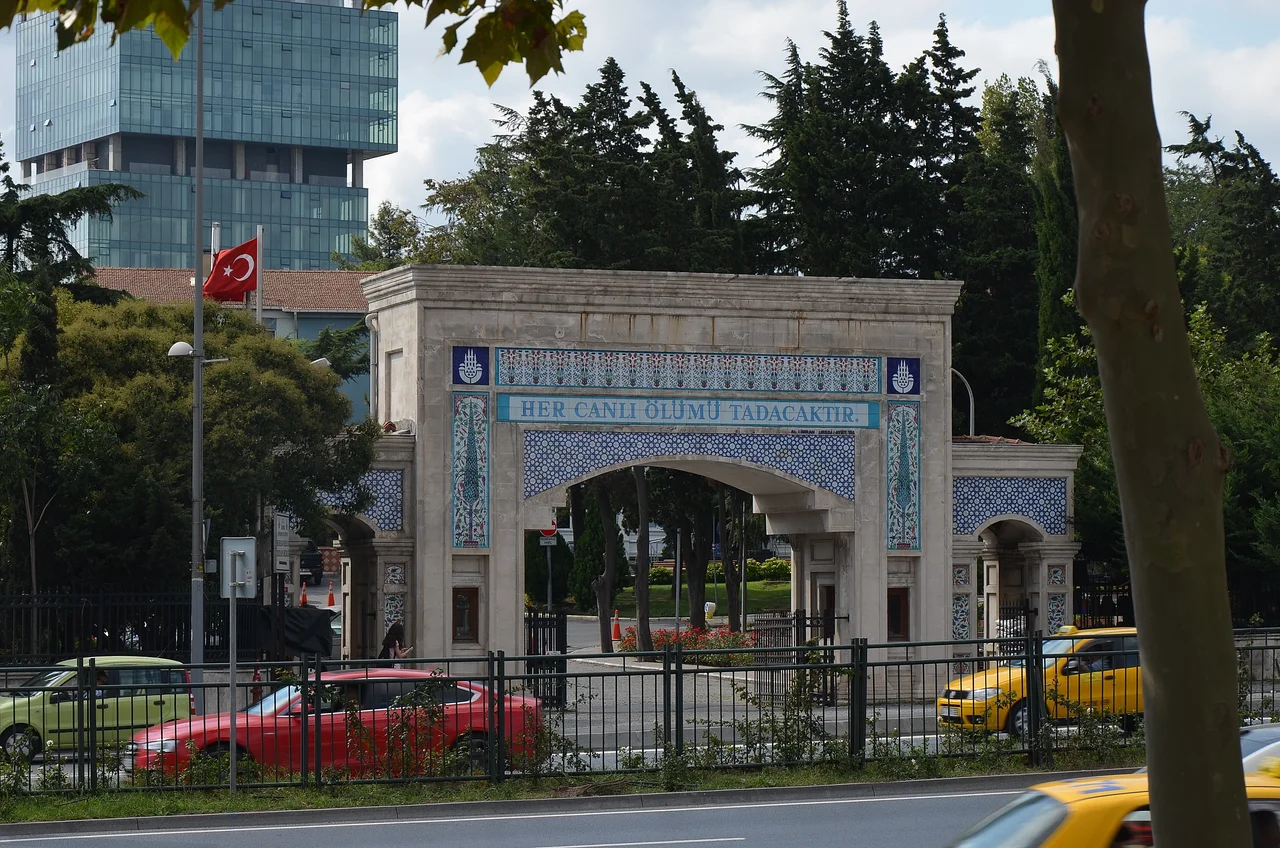

Zincirlikuyu Cemetery
Over the gate at the entrance, a verse from the Quran is inscribed in stone: "Her canlı ölümü tadacaktır" — Every living thing will taste death. It is not a threatening message. It is a leveling one. Inside Zincirlikuyu Cemetery, between Esentepe and Levent on Büyükdere Avenue, the hierarchy of Turkish public life reassembles itself in the democratic grammar of the dead. Prime ministers lie a few plots from folk singers. Novelists share the same hilltop with football coaches and stage magicians. Turkey's wealthiest man — Vehbi Koç — rests here, and so does the short-story writer Sait Faik Abasıyanık, who died nearly penniless. Planned in 1935 and filled to its boundaries by the 1950s, Zincirlikuyu is Istanbul's first cemetery organized as a contemporary institution rather than as a traditional religious burial ground — and its 0.381 square kilometers amount to a compressed, stone-marked biography of the Turkish Republic.
A Cemetery for the Modern Republic
Istanbul had cemeteries long before Zincirlikuyu. But they were organic accumulations — grounds attached to mosques, organized by neighborhood and community, with no central administration. Zincirlikuyu was something new: a secular municipal cemetery planned as an institution, conceived in 1935 as the young Turkish Republic was remaking virtually every aspect of civic life. Its location in what was then the edge of the European city — Şişli district, between neighborhoods that would grow into the financial heart of modern Istanbul — tells you something about the ambitions of the planners. This was not a place at the margins. It would eventually sit in the middle of things, on one of the busiest avenues in the city. A mosque inside the cemetery, built and donated by the Turkish entrepreneur İbrahim Bodur, was opened in April 2004, designed specifically for funeral prayers, with a capacity of 500 worshippers. By then the cemetery had long since filled — family graves are the only remaining space — so the mosque serves the dead who are already there.
Writers and Poets
The literary dead of Zincirlikuyu span the full range of 20th-century Turkish letters. Sait Faik Abasıyanık (1906–1954) wrote spare, luminous short stories about Istanbul's fishermen and street characters — he is sometimes called the Turkish Chekhov, a comparison that does justice to neither but conveys the affection. His mother Makbule Abasıyanık (1883–1963), a writer and philanthropist who established the Sait Faik Short Story Award in his memory, is buried nearby. Yaşar Kemal (1923–2015) wrote the great Kurdish-Turkish novel cycle centered on Çukurova, nominated repeatedly for the Nobel Prize. Orhan Kemal (1914–1970) gave literary form to the lives of factory workers and migrants. Refik Halit Karay (1888–1965) wrote biting satirical fiction that earned him exile under three different governments — his headstone marks the end of a turbulent life. Behçet Necatigil (1916–1979) and Faruk Nafiz Çamlıbel (1898–1973) represent the poets. Duygu Asena (1946–2006) wrote the feminist novel that became a cultural landmark. Between them, this one cemetery holds something close to a library of modern Turkish literature.
Statesmen, Artists, and Athletes
Zincirlikuyu is also where the Turkish Republic buried many of its builders and breakers. Five prime ministers rest here: Ali Fethi Okyar, Hasan Saka, Şükrü Saracoğlu, Nihat Erim, and Naim Talu. İhsan Sabri Çağlayangil, who served as Foreign Minister and Senate Chairman, is here. So is Benal Nevzat İstar Arıman (1903–1990), one of the first eighteen women elected to the Turkish Parliament. From the arts: Muhsin Ertuğrul (1892–1979), the founder of modern Turkish theatre, and the actors Sadri Alışık, Kemal Sunal, and Belgin Doruk, beloved faces of Turkish cinema's golden decades. Şükrü Saracoğlu, besides being Prime Minister, was president of Fenerbahçe — so the football club's most important historical leader is buried in the same ground as rival football coaches and players. Zati Sungur (1898–1984), who was Turkey's most celebrated stage magician, is here. The folk singer Ruhi Su (1912–1985) and the classical singer Müzeyyen Senar (1918–2015), two of the defining voices of Turkish music, share the hill. No category of Turkish public life is absent.
A City's Memory, Kept in Stone
What Zincirlikuyu ultimately preserves is not so much individual fame as collective texture — the sense of what it meant to live a public life in Turkey across the tumultuous 20th century. Some of the dead were exiled and later celebrated. Some were imprisoned and some were assassinated. The journalist Çetin Emeç (1935–1990) was killed by gunmen in Istanbul, and is buried here. The scientist and statesman Erdal İnönü (1926–2007), son of Turkey's second president, navigated the country's political upheavals as both a physicist and a politician. The novelist Sevgi Soysal (1936–1976) died young, her short life marked by imprisonment. They rest in this 38-hectare cemetery on Büyükdere Avenue, among the noise of one of Istanbul's busiest roads, the modern city pressing against the walls on every side. The verse above the gate does not distinguish between them.
From the Air
Zincirlikuyu Cemetery sits at approximately 41.0738°N, 29.0079°E in the Şişli district of European Istanbul, beside Büyükdere Avenue between the Esentepe and Levent neighborhoods. From the air at 1,500–3,000 feet, the cemetery is identifiable as a large green rectangle amid the dense commercial and residential development of Istanbul's financial district — the gleaming towers of Levent are immediately to the north, providing a clear landmark. The nearest airport is Istanbul Airport (LTFM), approximately 20 km to the northwest. The Bosphorus is visible a few kilometers to the east.
Nearby Stories
- Kocaeli Peninsula 7.6 km away
- Second Battle of Çatalca 11 km away
- Istanbul's Rural Outskirts 14 km away
- MV Struma 20 km away
- HMAS AE2 36 km away
- Bursa 66 km away
- Sangarius Bridge 71 km away
- Januarius MacGahan 101 km away